
 Kontakt
 Ako nakupovať
Doručenie
Nákupný poradca
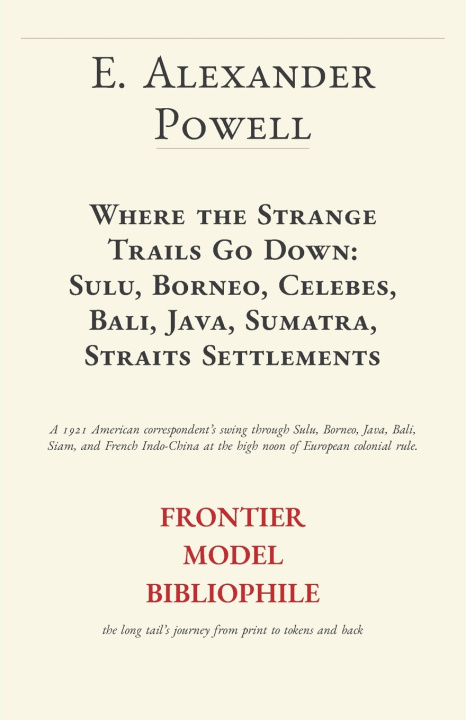
Where the Strange Trails Go Down
Sulu, Borneo, Celebes, Bali, Java, Sumatra, Straits Settlements
 Angličtina
 69 b
69 b
 Pripravujeme
 Nové
Nové
 Termín neznámy
Až 30 dní na vrátenie tovaru

In 1921, the American foreign correspondent E. Alexander Powell - already a familiar byline from the Western Front, Italy at War, and the Mexican border - turned south and east. With a motion-picture cameraman named Hawkinson in tow, he ran the length of Malaysia (as he insists on calling it): from the Sulu Archipelago of the American Philippines down through British North Borneo, the Dutch East Indies, the Straits Settlements, the Federated Malay States, and on into Siam, Cambodia, and French Cochin-China. The result is a Scribner's travel book in the high lecture-circuit style - bull-fights at Parang, Dyak head-hunters with sumpitan and kris, the volcano of Bromo, the kraton of Djokjakarta, the royal ballet at Pnom-Penh - laid over a working journalist's running assessment of how the Dutch, the British North Borneo Company, and the French administered tropical Asia between the wars. This Frontier Model Bibliophile edition reprints the 1921 Scribner's first edition with a full editorial apparatus.
Where the Strange Trails Go Down is a 1921 travel-adventure book of the lecture-circuit kind, written by a sitting Scribner's author at the top of his marketing arc. The genre is recognizable from the page: twelve chapters, a foreword, a fold-out map of Malaysia, a frontispiece ("A real wild man of Borneo"), thirty-odd photographic plates, and a dedication to a widow who, the dedication notes, "despite countless discomforts, always kept smiling." E. Alexander Powell, by then forty-two, had spent most of the previous decade filing war reportage - Flanders, France, Italy, the American mobilization, the postwar Balkan and Near Eastern settlements - and turning each tour into a Scribner's hardcover. With the Great War over and the lecture circuit hungry for new terrain, he booked passage to the Philippines, picked up a motion-picture cameraman named Hawkinson, and ran the strange-trails circuit Scribner's prints on the title page: Sulu, Borneo, Celebes, Bali, Java, Sumatra, Straits Settlements, Malay States, Siam, Cambodia, Annam, Cochin-China. What distinguishes the book within Powell's own shelf is that it is the first of his volumes to leave Europe and the trans-Atlantic political settlement behind entirely; it is also the first in which the cameraman is a constant on-page presence, staging the night arrival of the Sultan of Sulu under magnesium flares and pressing for action shots at Moro war-dances. The voice is unmistakable American magazine prose of the period, pitched for the parlor and the Chautauqua hall, but the reportorial instinct underneath is steady throughout. The world it came from is the world of October 1921. The Treaty of Versailles had been in force for less than two years; the Washington Naval Conference, which would limit Pacific capital-ship tonnage and reorganize the security order Powell was about to describe, opened the month after this book appeared. The Netherlands ruled the Insulinde from Batavia under the Ethical Policy; the British Crown ruled Malaya through Residents and the Federated structure codified after 1874; the British North Borneo Company - a chartered company in the old East India Company mold, operating under royal charter of 1881 - still administered the territory that would later become Sabah; the French had completed the consolidation of Indo-China under a single Governor-General in 1887; and the United States, four years past the Jones Act and twelve years before Tydings-McDuffie, governed Sulu and the rest of the archipelago through an Insular bureaucracy that Powell observed at close range. Powell does not pretend to neutrality among these regimes. He weighs the Dutch system, the chartered-company system, the French system, and the American system against each other with the matter-of-factness of a foreign correspondent rating armies.


Informácie o knihe
Angličtina

Darujte túto knihu ešte dnes
Je to jednoduché
1 Pridajte knihu do košíka a vyberte možnosť doručiť ako darček 2 Obratom Vám zašleme poukaz 3 Knihu zašleme na adresu obdarovanéhoAhoj! Som Libroamiko, tvoj knižný radca.
Ako ti môžem pomôcť?