
 Kontakt
 Ako nakupovať
Doručenie
Nákupný poradca
 Angličtina
 80 b
80 b
 Nové
Nové
Až 30 dní na vrátenie tovaru
Zákazníci tiež kúpili





 /
/
 Pevná
Pevná
 43.15
€
43.15
€

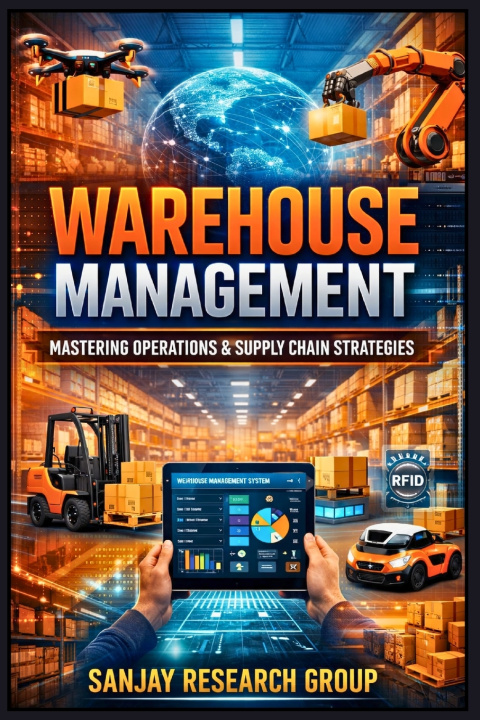
Warehouse Management: Mastering Operations and Supply Chain Strategies provides a systematic and practical understanding of warehouse operations within the broader supply chain framework. The book is carefully organized into thirteen comprehensive chapters, each designed to build knowledge progressively from foundational concepts to advanced technological trends.
Chapter 1 - Introduction
This chapter establishes the core foundation by explaining the definition, objectives, importance, advantages, and limitations of warehouse management. It highlights the role of warehouses in business operations and supply chain efficiency.
Chapter 2 - Types of Warehouses
Readers explore different types of warehouses, including private, public, bonded, automated, distribution centers, and climate-controlled facilities, along with their specific uses and operational characteristics.
Chapter 3 - Warehouse Design and Layout
This chapter focuses on warehouse planning, layout structures (U-shaped, I-shaped, L-shaped), space utilization, storage planning, and docking arrangements to maximize operational efficiency.
Chapter 4 - Storage Systems and Methods
Detailed explanations of block stacking, shelving systems, mezzanine floors, and Automated Storage and Retrieval Systems (AS/RS) are provided to help understand storage optimization strategies.
Chapter 5 - Material Handling in Warehousing
The principles of material handling, equipment types, automation systems, and safety considerations are discussed to improve operational productivity and reduce handling costs.
Chapter 6 - Warehouse Operations Process
This chapter outlines the complete warehouse workflow, including receiving, put-away, picking, packing, shipping, and reverse logistics processes.
Chapter 7 - Inventory Control in Warehousing
It explains inventory classification techniques such as ABC analysis, stock rotation methods (FIFO, LIFO, FEFO), inventory accuracy, and the role of barcodes and RFID in tracking.
Chapter 8 - Role of Technology in Warehouse Management
Modern systems such as Warehouse Management Systems (WMS), robotics, IoT, and data analytics are examined to demonstrate how technology enhances operational performance.
Chapter 9 - Safety and Security in Warehousing
Covers safety regulations, fire protection measures, security systems, hazardous material handling, and employee safety training protocols.
Chapter 10 - Performance Management
Introduces key performance indicators (KPIs), benchmarking methods, and strategies for continuous improvement.
Chapter 11 - Challenges
Identifies common warehouse challenges including space limitations, labor management, shrinkage, seasonal demand fluctuations, and supply chain integration issues.
Chapter 12 - Best Practices
Highlights lean warehousing, Just-in-Time (JIT) systems, cross-docking techniques, and sustainable warehousing strategies.
Chapter 13 - Future Trends
Explores emerging innovations such as AI, machine learning, robotics, autonomous vehicles, drones, cloud-based systems, and smart warehousing aligned with Industry 4.0.
This structured approach ensures that readers gain both theoretical understanding and practical insight into warehouse management. The book aims to serve as a reliable academic resource as well as a practical guide for professionals.
Sanjay Research Group


Informácie o knihe
Angličtina

Darujte túto knihu ešte dnes
Je to jednoduché
1 Pridajte knihu do košíka a vyberte možnosť doručiť ako darček 2 Obratom Vám zašleme poukaz 3 Knihu zašleme na adresu obdarovanéhoMohlo by vás tiež zaujímať


Ahoj! Som Libroamiko, tvoj knižný radca.
Ako ti môžem pomôcť?