
 Kontakt
 Ako nakupovať
Doručenie
Nákupný poradca
Virtual Turning Points
 Angličtina
 125 b
125 b
Až 30 dní na vrátenie tovaru
Zákazníci tiež kúpili




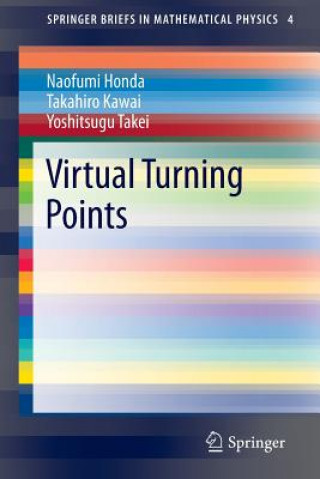
The discovery of a virtual turning point truly is a breakthrough in WKB analysis of higher order differential equations. This monograph expounds the core part of its theory together with its application to the analysis of higher order Painlevé equations of the Noumi-Yamada type and to the analysis of non-adiabatic transition probability problems in three levels.§§As M.V. Fedoryuk once lamented, global asymptotic analysis of higher order differential equations had been thought to be impossible to construct. In 1982, however, H.L. Berk, W.M. Nevins, and K.V. Roberts published a remarkable paper in the Journal of Mathematical Physics indicating that the traditional Stokes geometry cannot globally describe the Stokes phenomena of solutions of higher order equations; a new Stokes curve is necessary. Later, T. Aoki, T. Kawai, and Y. Takei discovered the notion of a virtual turning point by applying microlocal analysis to Borel-transformed WKB solutions; a new Stokes curve is a Stokes curve emanating from a virtual turning point. An important point is that the notion of a virtual turning point is intrinsically defined in the sense that it does not depend on the argument of the large parameter contained in the equation, contrary to the case of new Stokes curves. At the same time, as the qualifier "virtual" indicates, a virtual turning point cannot be detected by a cosmetic study of ordinary WKB solutions; we need the conversion of the study to the one on a different space, the Borel plane. This is the reason a virtual turning point was not found before the advent of the exact WKB analysis, the analysis of Borel-transformed WKB solutions.§


Informácie o knihe
Angličtina

Darujte túto knihu ešte dnes
Je to jednoduché
1 Pridajte knihu do košíka a vyberte možnosť doručiť ako darček 2 Obratom Vám zašleme poukaz 3 Knihu zašleme na adresu obdarovanéhoMohlo by vás tiež zaujímať

Ahoj! Som Libroamiko, tvoj knižný radca.
Ako ti môžem pomôcť?