
 Kontakt
 Ako nakupovať
Doručenie
Nákupný poradca
 Čínština
 69 b
69 b
Až 30 dní na vrátenie tovaru

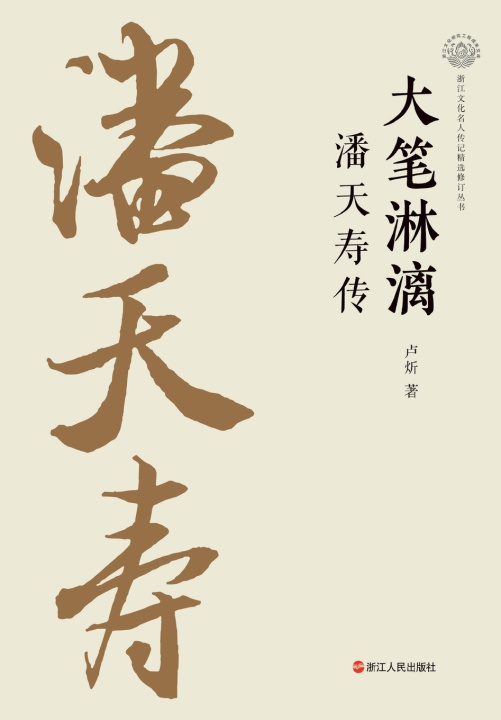
The title The Uninhibited Brush: A Biography of Pan Tianshou is derived from a seven-character quatrain composed by Pan Tianshou himself. The poem reads:
"My rough-hewn writings are uniquely ancient,
My scattered calligraphy and painting possess even greater spirit.
With a giant brush freely wielding its ink,
I stand as the foremost master in three hundred years."
This poem was inscribed by Pan on a handscroll of ink flowers by Xu Tianchi. Xu Tianchi (1521-1593), known as Xu Wei and also by the sobriquet Qingteng, was a native of Shanyin (present-day Shaoxing), Zhejiang Province. He was a distinguished painter who founded the school of freehand ink painting, as well as a renowned playwright (author of the zaju play The Four Cries of the Gibbon). Throughout his life, he endured poverty and hardship, never flattering those in power. His paintings exemplify the principle of "method within methodlessness" and "ordered within apparent disorder." The Ming Dynasty Painting Record states that he began studying flower painting in middle age; initially appearing casual, his brushwork was natural and effortless, radiating a spontaneous charm-comparable to a common monk attaining sainthood. Pan Tianshou honored Xu with the appraisal "the foremost master in three hundred years," revealing his profound admiration for Xu Wei and reflecting a spiritual kinship between two great artists separated by centuries. Was Pan himself any different? His achievements and character also entitle him to be regarded as a paragon of artistic attainment. I feel deeply honored to write a biography for such a master painter, yet although I have written four or five biographies of varying lengths since 1983, I still find many regrets in my work.
《大笔淋漓:潘天寿传》的书名出自潘天寿先生一首七绝,全诗为:"草草文章偏绝古,披离书画更精神。如椽大笔淋漓在,三百年中第一人。"此诗题于徐天池墨花长卷。徐天池(152l-1593)即徐渭,号青藤,浙江山阴(今绍兴)人,他是开大写意画派的杰出画家,又是著名剧作家(杂剧《四声猿》),一生潦倒,从不妩媚权势。其画"无法中有法","乱而不乱"。《明画录》谓其中岁始学花卉,初不经意,涉笔潇洒,天趣灿发,可称散僧人圣。潘天寿先生以"三百年中第一人"许之,可见其对徐渭的钦佩,也可视为相距数百年的大艺术家之神交。潘先生何尝不是如此,以其成就和人格也可谓人圣。为画圣立传我深感荣幸,但自1983年以来二十年间虽写过四五种篇幅不等的传记,总还留有不少遗憾。
Lu Xin, born in Hangzhou, Zhejiang Province in 1944, is a professor at the China Academy of Art, Director of the Pan Tianshou Memorial Museum, Executive Council Member and Secretary-General of the Pan Tianshou Foundation, and a member of the China Artists Association. He has engaged in research on modern and contemporary art for many years and concurrently serves as Secretary-General of the China Federation of Calligraphy and Painting Masters' Memorial Museums. In recent years, he has also devoted himself to museum studies. He has published more than ten works, including several biographies of Pan Tianshou, Studies on Pan Tianshou, An Annotated Edition of Pan Tianshou's Collected Poems, Critical Appreciation of Pan Tianshou's Masterpieces, and An Annotated Sequel to Three Hundred Tang Poems.
卢忻,1944年生于浙江杭州,中国美术学院教授、潘天寿纪念馆馆长、潘天寿基金会常务理事兼秘书长、中国美术家协会会员。从事近现代美术研究多年,兼任中国书画名家纪念馆联会秘书长,近年又致力于美术馆研究。有《潘天寿》传记数种、《潘天寿研究》、《潘天寿诗存校注》、《潘天寿名画点评》、《唐诗三百首续选》校注等著作十余本问世。


Informácie o knihe
Čínština

Darujte túto knihu ešte dnes
Je to jednoduché
1 Pridajte knihu do košíka a vyberte možnosť doručiť ako darček 2 Obratom Vám zašleme poukaz 3 Knihu zašleme na adresu obdarovanéhoAhoj! Som Libroamiko, tvoj knižný radca.
Ako ti môžem pomôcť?