
 Kontakt
 Ako nakupovať
Doručenie
Nákupný poradca
 Angličtina
 58 b
58 b
 Pripravujeme
 Nové
Nové
Až 30 dní na vrátenie tovaru

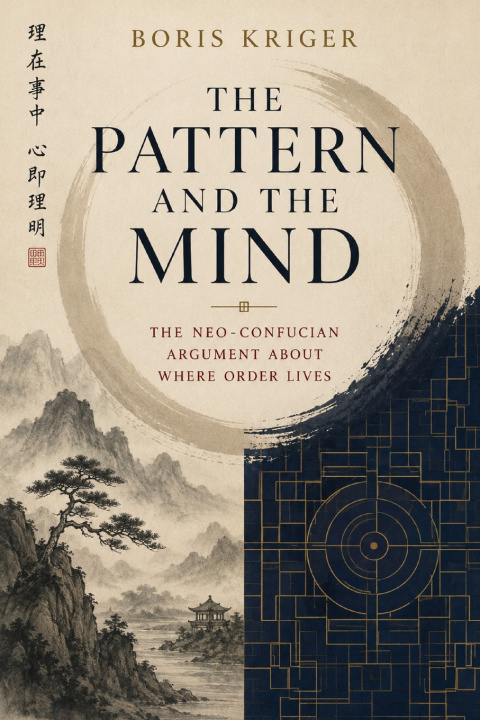
For six hundred years, every educated man in China, and for much of that time in Korea and Vietnam as well, was examined on the commentaries of one twelfth-century scholar. Zhu Xi had asked where order lives and answered that it lives out there, in things, as a pattern the world already possesses and a patient student may come to know. Four centuries later Wang Yangming spent seven days staring at a stalk of bamboo, trying to reach the pattern inside it, and fell ill. He recovered with a heresy: that order lives nowhere but in the mind that recognizes it, and that his teacher's entire method had been an elaborate detour.
Between those two positions runs the longest continuous argument in the history of philosophy, and it was never merely academic. If the pattern is in things, it can be studied, tested, and graded, and whoever administers the test owns the principle. If the pattern is in the mind, anyone at all may reach it and no examiner can confirm that they have. Empires do not choose between these options on philosophical grounds. They choose the one that can be marked.
Boris Kriger approaches the dispute not as a sinologist but as a theorist of why systems last. Applying the diagnostic apparatus of his persistence framework to nine hundred years of Confucian argument, he shows that both wings of the tradition failed, on opposite boundaries of a single structural law: one by specifying its principle so completely that nothing was left to choose, the other by locating it so privately that nothing could be checked. He traces the exact institutional acts through which a program of open-ended inquiry became a syllabus, follows the machinery into Korea, Japan, and Vietnam, weighs the fierce prosecution mounted against it by later Confucians who accused it of killing people by means of principle, and asks why a doctrine so heavily indicted survived six centuries anyway.
The trail does not end in 1905 with the abolition of the examinations. It ends in a state that has recently declared traditional culture its root, in a national examination that decides the fate of ten million young people a year, in databases that render institutions legible, and finally in the rankings, metrics, and scores by which the reader's own competence is certified. The question of where order lives turns out to be the question of who is permitted to declare it - and that question has never been retired.
A sequel to Confucius and Social Harmony, written for readers who suspect that the systems grading them were designed by someone who is no longer available for comment.
Keywords: Neo-Confucianism, Zhu Xi, Wang Yangming, Chinese philosophy, intellectual history, institutions, authority


Informácie o knihe
Angličtina
Kategórie

Darujte túto knihu ešte dnes
Je to jednoduché
1 Pridajte knihu do košíka a vyberte možnosť doručiť ako darček 2 Obratom Vám zašleme poukaz 3 Knihu zašleme na adresu obdarovanéhoAhoj! Som Libroamiko, tvoj knižný radca.
Ako ti môžem pomôcť?