
 Kontakt
 Ako nakupovať
Doručenie
Nákupný poradca
 Angličtina
 32 b
32 b
 Nové
Nové
Až 30 dní na vrátenie tovaru

The engine knows. The player still has to move.
For most of chess history, the strongest available evaluation of a position lived inside the player. Now it lives on a phone. A modern engine on consumer hardware analyses any non-trivial position more accurately than the strongest unaided human, and a fair-play algorithm can second-guess every move within hours of the final handshake. The player still has to sit there for four or five hours and decide.
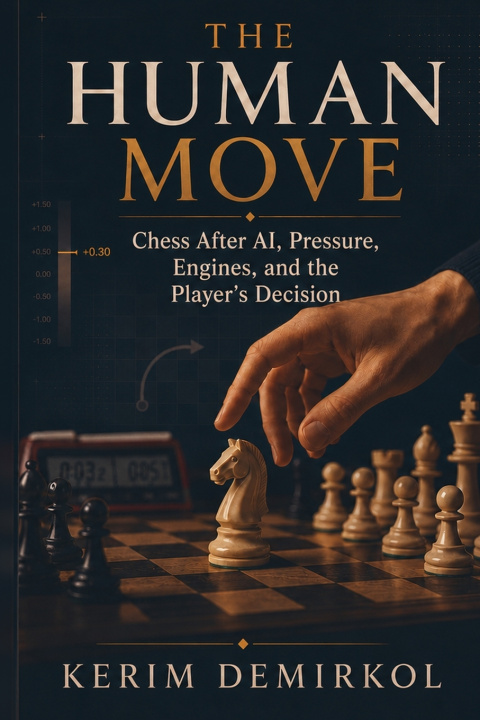
The Human Move is a serious, literary argument about what competitive chess has actually become in the engine era - and what it has always been. Written from inside the game by a competitive player based in Doha, the book makes a single sustained case across seven chapters: chess is not dying because engines became stronger. Chess is becoming clearer about what it always was, namely a sport of human decision under constraint.
What the book argues:
- Every modern game produces three verdicts within minutes of the final move - the result, the engine's grade, and the silent verdict on the self - and holding the boundary between them is the first skill of playing well in the engine era.
- Calculation and confidence are different cognitive objects. Knowing the line is not the same achievement as trusting the move under conditions, and the gap between them is the structural signature of training that has not been integrated.
- Pressure is not a feeling or a moral failure. It is a performance condition created by evaluation, consequence, and finite resources, with measurable cognitive effects supported by the published research on choking, attentional control, and decision under load.
- The engine evaluates positions. The player evaluates positions and conditions. The integration of those two evaluations, in a particular human at a particular board on a particular day, is the human contribution to the move.
- Cheating in chess is, structurally, an authorship problem before it is a rule violation. The integrity infrastructure of competitive chess exists to protect the structural condition without which the rating, the title, and the verdict have nothing to attach to.
- Chess is a sport in the philosophical sense the literature would recognise - and the institutional architecture, including IOC recognition since 1999 and FIDE's WADA signatory status, follows from that structural fact.
The final chapter turns the argument outward to the actors who shape the conditions under which players develop: players, parents, coaches, academies, platforms, federations, organisers, and the businesses that build chess products. Each layer has the same job stated differently.
Who this book is for: competitive players who want a serious account of the modern game from inside it; coaches and academies building developmental architecture for the engine era; parents of junior players trying to understand what their child is actually doing at the board; and readers of sport, cognitive science, and philosophy of competition who want chess treated as the test case it is.
Drawing on the published literature in cognitive science, sport psychology, and philosophy of sport, and on the institutional record of FIDE and the principal online chess platforms, The Human Move is a structural argument, not a self-help book and not a moral panic about artificial intelligence. The engine has clarified the contest. It has not abolished it. The future of chess is not human versus machine. It is human responsibility under machine review.
The Human Move is the first book in the Lessons from the Board series.


Informácie o knihe
Angličtina

Darujte túto knihu ešte dnes
Je to jednoduché
1 Pridajte knihu do košíka a vyberte možnosť doručiť ako darček 2 Obratom Vám zašleme poukaz 3 Knihu zašleme na adresu obdarovanéhoAhoj! Som Libroamiko, tvoj knižný radca.
Ako ti môžem pomôcť?