
 Kontakt
 Ako nakupovať
Doručenie
Nákupný poradca
 Angličtina
 26 b
26 b
 Nové
Nové
30 dní na vrátenie tovaru

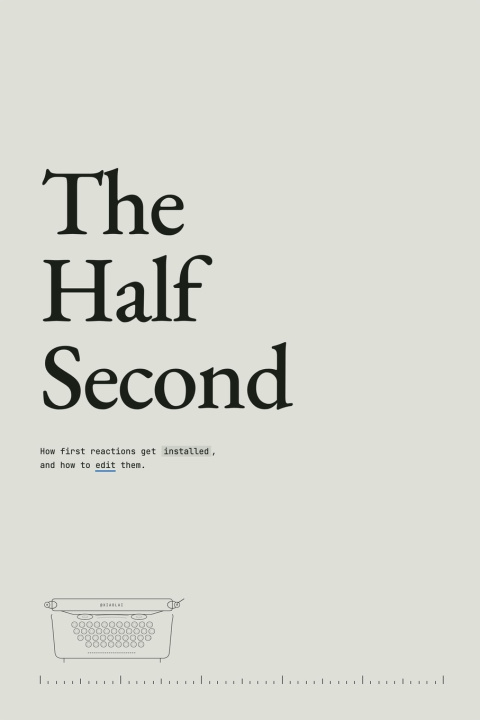
Most of what a person actually does is decided in the half-second before deliberation arrives.
The politician's face tightens before the conscious smile. The parent's voice sharpens before the patience returns. The smoker's hand reaches for the pack before the resolve to quit is recalled. By the standard of stated values, these moments do not represent who the speaker is. By the standard of the half-second, they do.
The Half Second is a book about the fast self that runs the day, the mechanism that built it, and the technique that edits it.
The mechanism is one. A frequency counter, running below the level of conscious thought, decides what feels familiar, what feels true, and what the body does next. It does not check. It does not weigh evidence. It counts how often a sentence has been heard. The sentence with the highest count wins. Repetition does the work that argument cannot.
This mechanism is what advertisers, politicians, religious leaders, and the people who raised the reader have been using to install reactions in the reader's half-second for years. It is also, the book argues, what cognitive therapy works through, what athletes use, what twelve-step programs rely on, and what makes habits stable. The mechanism is the same; the traditions are surface variations.
The book teaches the technique that lets the reader use the mechanism deliberately. Short scripts of the form Because I am X, when Y, I do Z, because R, said in the speaker's own voice, in the trigger contexts where the old reaction fires, repeated for months. The author quit a thirty-nine-year smoking habit by saying I never smoke to himself many thousands of times. The same form applies to the snap at the partner, the doomscroll at midnight, the inner voice that attacks the speaker before any external attack arrives.
The book is short, austere, and operational. It draws on contemporary cognitive psychology - Wendy Wood, Phillippa Lally, Peter Gollwitzer, Ethan Kross, Larry Squire, Daniel Kahneman - without footnoting itself into a textbook. It dismantles affirmations, NLP, and The Secret with care. It tells the reader, without flattery, what installs and what does not.
What the reader does with the writing is the reader's responsibility.


Informácie o knihe
Angličtina

Darujte túto knihu ešte dnes
Je to jednoduché
1 Pridajte knihu do košíka a vyberte možnosť doručiť ako darček 2 Obratom Vám zašleme poukaz 3 Knihu zašleme na adresu obdarovanéhoAhoj! Som Libroamiko, tvoj knižný radca.
Ako ti môžem pomôcť?