
 Kontakt
 Ako nakupovať
Doručenie
Nákupný poradca
 Angličtina
 77 b
77 b
 Nové
Nové
Až 30 dní na vrátenie tovaru

Canada and the United States remain separate countries. The boundary remains real. The laws are different. The governments are different. The courts, parliaments, and political cultures are not interchangeable. No serious account of the relationship can begin by pretending that sovereignty has disappeared.
Yet the continent does not operate as if the two countries are simply separate. Defence planning, energy systems, industrial supply chains, ports, grids, airspace, radar, pipelines, minerals, water, procurement, border administration, and northern geography have been organized for decades through patterns of coordination that exceed ordinary neighbourliness.
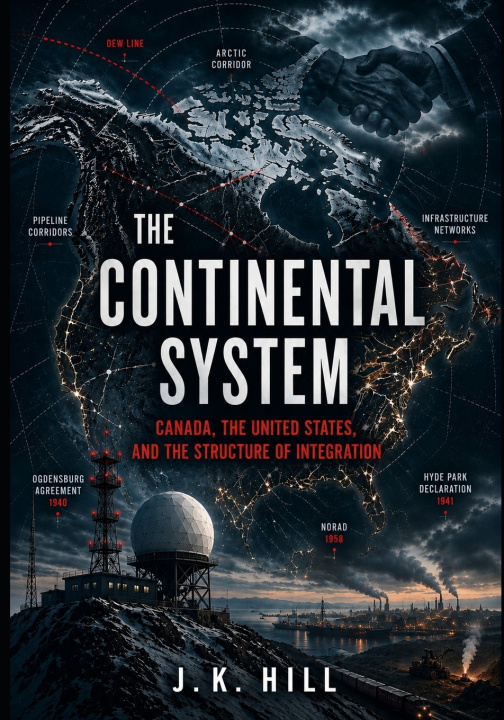
THE CONTINENTAL SYSTEM examines how this arrangement was built, how it works, and what it costs.
From the Depression's fiscal crisis (1929-1939) through wartime emergency coordination (Ogdensburg Agreement, Hyde Park Declaration, Alaska Highway) to Cold War defence integration (NORAD, radar lines, command structure) and contemporary resource politics (critical minerals, electrification, supply chain security), this book traces the institutional architecture through which the northern half of North America has been integrated without political merger.
Drawing on extensive archival research, policy documents, and legal analysis, J.K Hill argues that continental integration operates through negotiated coordination rather than formal consolidation. The system works through executive agreements, administrative synchronization, fiscal instruments, and infrastructure that creates path dependencies-not through constitutional amendment or political union.
What the book examines:
Part I: Depression & Wartime Foundations (1929-1945)
How fiscal crisis, emergency coordination, and wartime infrastructure established the template for binational cooperation without sovereignty loss.
Part II: NORAD & Defence Integration (1945-1968)
How temporary wartime arrangements became permanent institutions-command integration, radar lines, air defence, and the administrative habit of coordination.
Part III-VII: Infrastructure, Resources & Authority
Energy systems, pipelines, transmission lines, highways, boundary administration, Indigenous jurisdiction, provincial resource control, and the political economy of market access.
Part VIII: Contemporary Challenges (1990-2026)
NAFTA/USMCA, critical minerals, electrification, batteries, supply chain security, China, and the question of whether Canada prices what it provides.
The central question runs through every chapter: At the border, where movement becomes permission. In the provinces, where land becomes output. In Indigenous jurisdiction, where corridors encounter authority that cannot be reduced to consultation. In critical minerals, where geology is not enough unless processing, ownership, and market access can be secured.
Essential for: Scholars of Canadian-American relations, North American integration, federalism, resource politics, Indigenous law, border studies, defence policy, and political economy.


Informácie o knihe
Angličtina

Darujte túto knihu ešte dnes
Je to jednoduché
1 Pridajte knihu do košíka a vyberte možnosť doručiť ako darček 2 Obratom Vám zašleme poukaz 3 Knihu zašleme na adresu obdarovanéhoAhoj! Som Libroamiko, tvoj knižný radca.
Ako ti môžem pomôcť?