
 Kontakt
 Ako nakupovať
Doručenie
Nákupný poradca
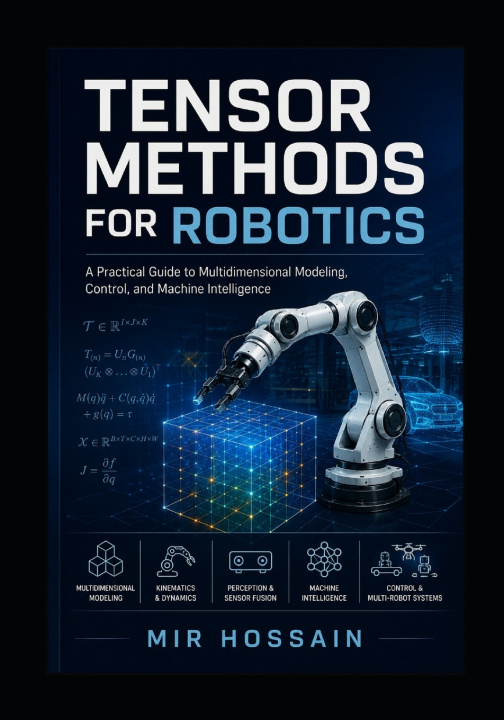
TENSOR METHODS FOR ROBOTICS
A Practical Guide to Multidimensional Modeling, Control, and Machine Intelligence
 Angličtina
 75 b
75 b
 Nové
Nové
30 dní na vrátenie tovaru

Master the mathematics powering modern robotics systems.
From autonomous vehicles and robotic manipulation to reinforcement learning and sensor fusion, today's robotics systems depend on tensors to process high-dimensional data efficiently and intelligently. Tensor Methods for Robotics delivers a practical, engineering-focused guide to applying tensor mathematics in real robotic systems.
Designed for graduate students, robotics engineers, AI researchers, and advanced developers, this book bridges the gap between classical robotics and modern machine learning by showing how tensors unify perception, control, kinematics, dynamics, and deep learning.
Inside this comprehensive guide, you will learn:
Tensor fundamentals for robotics and machine intelligence
Coordinate frames, SE(3), Lie groups, and tensor-based kinematics
Batched Jacobians, dynamics, and motion planning
Tensor methods for computer vision and sensor fusion
Probabilistic tensors, covariance propagation, and uncertainty modeling
Deep learning architectures for robotics applications
Tensor decompositions including CP, Tucker, and Tensor Train
Reinforcement learning with high-dimensional tensor representations
Multi-robot systems and soft robotics modeling
Practical Python implementations using NumPy and PyTorch
Real-world robotics case studies and implementation workflows
This book emphasizes practical engineering intuition alongside rigorous mathematics. Every chapter includes:
Worked examples
Implementation boxes with runnable Python code
Common pitfalls
Mini projects
Self-tests and exercises with solutions
Whether you are building robotic perception pipelines, training autonomous agents, optimizing control systems, or researching next-generation AI robotics, this book provides the tensor tools needed to work effectively with modern multidimensional robotics data.
Ideal for:
Robotics engineers
Graduate students
AI and machine learning practitioners
Autonomous systems developers
Computer vision researchers
Control systems engineers
Advanced STEM learners
Build robotics systems that scale beyond vectors and matrices - and start thinking in tensors.


Informácie o knihe
Angličtina
