
 Kontakt
 Ako nakupovať

Doručenie
Nákupný poradca
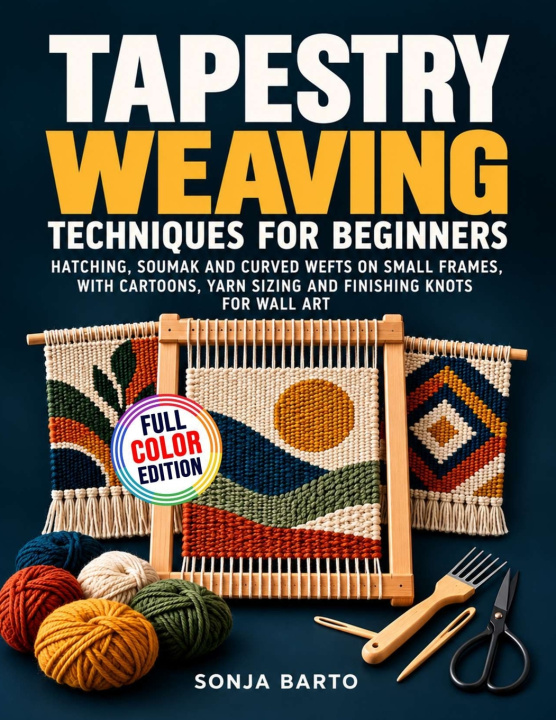
Tapestry Weaving Techniques for Beginners
Hatching, Soumak and Curved Wefts on Small Frames, with Cartoons, Yarn Sizing and Finishing Knots for Wall Art
 Angličtina
 60 b
 Nové
Až 30 dní na vrátenie tovaru

Real tapestry needs a floor loom, the thinking goes, and a frame small enough to balance on your knees can manage little more than stripes and the occasional lopsided rectangle, while curves and soft color shifts belong to weavers with bigger equipment.
Nothing in this book asks for a floor loom. Only the weft ever shows in a tapestry, so a soft color shift or a curve is decided by how the weft is laid, not by how big the loom is.
What holds a first panel back is usually one missing move, such as blending two colors without a seam, wrapping a line above the surface, or bending a row into an arc, and each of those moves is a skill with steps you can count, drilled in a technique chapter before a project ever asks for it.
Gradients, Curves and Raised Lines
- Color blending by hatching: two wefts trade places pass by pass until the eye reads a third color that is not anywhere in your yarn basket.
- Soumak wraps the weft over two warp threads and back under one; the result is a raised, corded line that plain weave alone cannot make.
- Curved wefts stack graduated passes inside a bounded zone, which is how a wave crest or a hill gets its shape on a warp that runs dead straight.
- Slits can stay open as a design choice, or close with a single interlock or a dovetail when the edge runs long or borders a soft transition.
- How does a photograph become a weaving? A full-size cartoon behind the warp reduces it to clean color shapes a loom can actually hold.
- Cotton warp twine and worsted wool at 8 ends per inch, plus a wraps-per-inch test for any yarn whose label does not describe its true thickness.
A tapestry is finished twice: once when the last row goes in, and again when the warp ends are secured while the loom is still holding them taut. Skip the second, and the first row you wove is one gentle tug from sliding loose, which is why the finishing chapters come before the framing.
Five Panels on One Small Frame
- Five original patterns, from the First Colour-Block Sampler to the Combined-Technique Landscape Panel, each at 8 ends per inch.
- Beat with a tapestry fork, a comb beater, or a sturdy dinner fork; the shed stick stays optional at this foundational level.
- Controlling selvedges: bubbling the weft keeps the edges parallel, and fixing errors early costs a few rows, not a full reweave.
- Finishing runs from knotted fringe and a damascus edge to a stitched hem, then mounting methods from sleeve and dowel to padded board.
- Dressing frame looms notch by notch with one continuous warp thread, plus tension checks that catch a slack end before weaving starts.
Every skill a project needs is taught before the project begins, so the sampler, the gradient panel, the soumak hanging, the wave panel, and the landscape each lean on chapters you have worked through.
Texture and color both come from the same small frame, and the last two chapters take each piece from the loom to the wall, including a padded-board mount with a gallery-ready finish and the blocking and hardware choices that keep a piece square once it hangs.
This is the book that lives on the worktable, not the shelf, with the fork and a ball of worsted close at hand.


Informácie o knihe
Angličtina

Darujte túto knihu ešte dnes
Je to jednoduché
1 Pridajte knihu do košíka a vyberte možnosť doručiť ako darček 2 Obratom Vám zašleme poukaz 3 Knihu zašleme na adresu obdarovanéhoAhoj! Som Libroamiko, tvoj knižný radca.
Ako ti môžem pomôcť?