
 Kontakt
 Ako nakupovať

Doručenie
Nákupný poradca
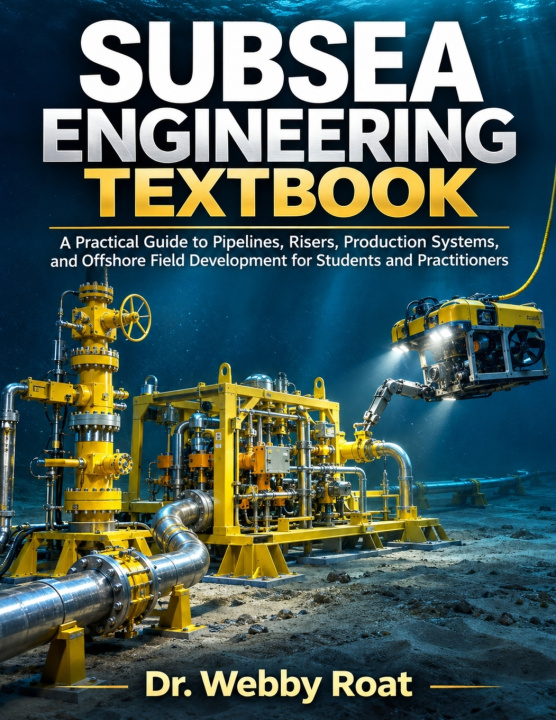
Subsea Engineering Textbook
A Practical Guide to Pipelines, Risers, Production Systems, and Offshore Field Development for Students and Practitioners
 Angličtina
 398 b
 Pripravujeme
 Nové
Až 30 dní na vrátenie tovaru

Master the Science, Technology, and Engineering Behind Modern Subsea Oil and Gas Production
How are complex oil and gas production systems designed, installed, and operated thousands of feet beneath the ocean surface? What engineering principles keep subsea pipelines, risers, wellheads, and offshore production facilities functioning safely and reliably in demanding deepwater environments?
The answers lie in understanding the engineering principles, technologies, and practical decisions that make modern subsea developments possible.
Subsea Engineering Textbook is a comprehensive, application-focused engineering reference that explores the design, analysis, installation, operation, and integrity management of subsea oil and gas production systems.
Combining essential engineering theory with practical calculations, detailed technical explanations, and realistic worked examples, this textbook provides a systematic approach to understanding the interconnected systems that support offshore field development.
Written for petroleum engineering students, mechanical engineers, offshore engineers, marine engineering students, early-career subsea engineers, and practicing professionals, this resource bridges the gap between classroom fundamentals and real-world offshore engineering challenges.
WHAT YOU WILL LEARNSubsea Engineering Fundamentals and Field Development: Understand offshore field architecture, subsea development concepts, deepwater operating environments, and the engineering decisions involved in offshore project planning.
Subsea Production Systems and Equipment: Explore subsea wellheads, christmas trees, production manifolds, jumpers, valves, chokes, and the mechanical systems that control underwater oil and gas production.
Subsea Control Systems and Umbilicals: Learn how electrohydraulic controls, electrical power, communication systems, hydraulic actuators, and umbilicals support reliable subsea operations.
Flow Assurance and Multiphase Flow: Examine fluid dynamics, pressure losses, heat transfer, pipeline insulation, hydrate formation, wax deposition, scale, and slugging in subsea production networks.
Subsea Pipeline Design and Structural Analysis: Develop an understanding of pipeline wall thickness, external pressure collapse, thermal expansion, buckling, on-bottom stability, free-span assessment, and structural integrity.
Offshore Pipeline Installation Engineering: Study S-lay, J-lay, reel-lay, installation vessel operations, pipeline tension, offshore construction methods, and subsea connection procedures.
Riser Engineering and Floating Production Interfaces: Explore steel catenary risers, flexible risers, top-tensioned systems, lazy-wave configurations, hydrodynamic loading, vibration, and fatigue behavior.
Corrosion Control and Cathodic Protection: Understand subsea corrosion mechanisms, protective coatings, material selection, sacrificial anode systems, and long-term corrosion management.
Marine Operations, ROVs, and Subsea Intervention: Examine underwater inspection technologies, remotely operated vehicles, offshore lifting operations, installation planning, and subsea maintenance techniques.
Subsea Integrity, Reliability, and Safety: Learn the principles of inspection planning, pipeline monitoring, defect assessment, subsea equipment reliability, repair strategies, and operational risk management.
Subsea Processing and Decommissioning: Discover subsea pumping, separation, gas compression, system qualification, and end-of-life considerations for offshore production assets.


Informácie o knihe
Angličtina

Darujte túto knihu ešte dnes
Je to jednoduché
1 Pridajte knihu do košíka a vyberte možnosť doručiť ako darček 2 Obratom Vám zašleme poukaz 3 Knihu zašleme na adresu obdarovanéhoAhoj! Som Libroamiko, tvoj knižný radca.
Ako ti môžem pomôcť?