
 Kontakt
 Ako nakupovať
Doručenie
Nákupný poradca
 Angličtina
 44 b
44 b
30 dní na vrátenie tovaru

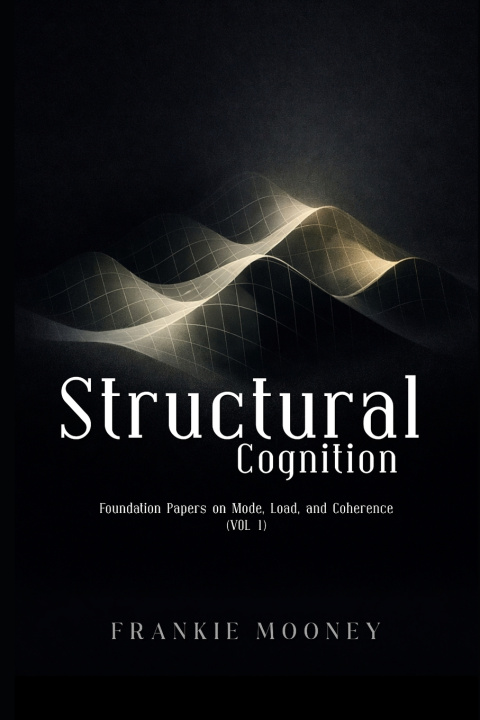
Structural Cognition presents the foundational papers of a new scientific domain concerned not with behaviour, belief, or interpretation, but with the internal architecture that governs cognitive movement under load.
Across ten formal essays, Frankie Mooney introduces and develops the Dual-Mode Elicitation Model (DEM): a structural framework for understanding how cognition shifts, stabilises, deforms, and reorganises during real-time interaction. The work reframes human communication, influence, and decision-making as emergent properties of underlying architectural conditions rather than products of intention, personality, or persuasion.
The essays in this volume establish core principles including:
- dual-mode cognitive operation
- real-time cognitive topology
- load-driven deformation and recovery
- coherence as a structural property
- mode switching as adaptive intelligence
- the limits of linear communication models
- influence as structural alignment rather than persuasion
The latter essays extend these principles into the domain of artificial intelligence, outlining how DEM informs the design of synthetic cognitive architectures capable of interpretable state, deterministic dynamics, and coherence under pressure. These foundations underpin ARCITECT® Technologies, a research initiative exploring state-based synthetic cognition.
This volume is not a guide, manual, or self-help text.
It does not offer techniques, advice, or optimisation strategies.
It is a formal groundwork.
Structural Cognition is intended for researchers, systems thinkers, technologists, and readers interested in the architecture beneath behaviour - those seeking to understand not what minds do, but how they are structurally able to do it.


Informácie o knihe
Angličtina
