
 Kontakt
 Ako nakupovať
Doručenie
Nákupný poradca
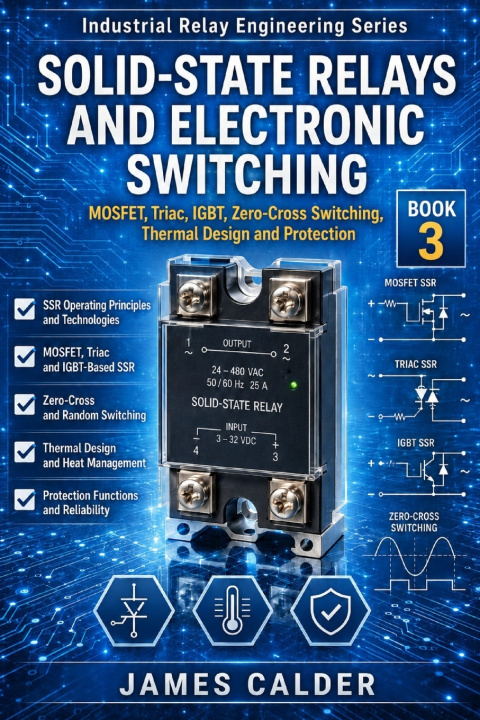
SOLID-STATE RELAYS AND ELECTRONIC SWITCHING
MOSFET, Triac, IGBT, Zero-Cross Switching, Thermal Design and Protection
 Angličtina
 57 b
57 b
 Nové
Nové
Až 30 dní na vrátenie tovaru

SOLID-STATE RELAYS AND ELECTRONIC SWITCHING
Solid-state relays are widely used in modern industrial systems where fast switching, long service life, silent operation, electrical isolation, and high switching frequency are required. Unlike electromechanical relays, they have no moving contacts, but that does not mean they are simple or failure-free.
SOLID-STATE RELAYS AND ELECTRONIC SWITCHING is a practical engineering guide to the selection, application, thermal design, protection, and troubleshooting of semiconductor switching devices used in industrial automation and control systems.
The book explains how MOSFET, triac, IGBT, and related switching technologies behave under real electrical loads and why current ratings alone are not enough for reliable design.
What You Will Learn
Operating principles of solid-state relays
Differences between AC and DC SSRs
MOSFET, triac, SCR, and IGBT switching
Zero-cross and random-turn-on switching
Input control circuits and isolation
Output voltage drop and conduction losses
Leakage current in the OFF state
Minimum load current and holding current
Switching resistive, inductive, capacitive, and heating loads
Inrush current and repetitive switching stress
dv/dt and di/dt limitations
Heat generation and thermal resistance
Heatsink selection and thermal design
Junction temperature and safe operating margins
Derating for ambient temperature and current
Short-circuit and overload protection
Fuses, circuit breakers, varistors, and RC snubbers
EMI and electrical noise generated by switching
Failure modes of semiconductor relays
Open-circuit, short-circuit, leakage, and thermal failures
Practical testing and diagnostic methods
Correct replacement and application selection
Practical Engineering Approach
A solid-state relay may appear to switch correctly and still cause machine problems. Leakage current can keep a small load partially energized. Excessive voltage drop can generate unexpected heat. Poor heatsink selection can destroy a relay even when the load current is below the printed rating.
This book connects semiconductor theory with real industrial symptoms.
Readers learn how to evaluate the complete switching path from the control signal to the load, calculate thermal stress, understand datasheet limits, identify unsuitable load conditions, and select protective components that reduce the risk of repeated failures.
The emphasis is on practical decisions: choosing the correct SSR type, understanding the load, controlling temperature, protecting the semiconductor output, and diagnosing faults without replacing components by trial and error.
Who This Book Is For
This book is intended for industrial electricians, maintenance technicians, automation engineers, electrical engineers, PLC programmers, panel builders, machine builders, commissioning technicians, service personnel, and engineering students.
It is especially useful for professionals working with heaters, solenoids, contactors, motors, DC loads, high-cycle switching, PLC outputs, and industrial control panels where semiconductor switching offers advantages over mechanical contacts.
This is Book 3 of the Industrial Relay Engineering Series.


Informácie o knihe
Angličtina

Darujte túto knihu ešte dnes
Je to jednoduché
1 Pridajte knihu do košíka a vyberte možnosť doručiť ako darček 2 Obratom Vám zašleme poukaz 3 Knihu zašleme na adresu obdarovanéhoAhoj! Som Libroamiko, tvoj knižný radca.
Ako ti môžem pomôcť?