
 Kontakt
 Ako nakupovať

Doručenie
Nákupný poradca
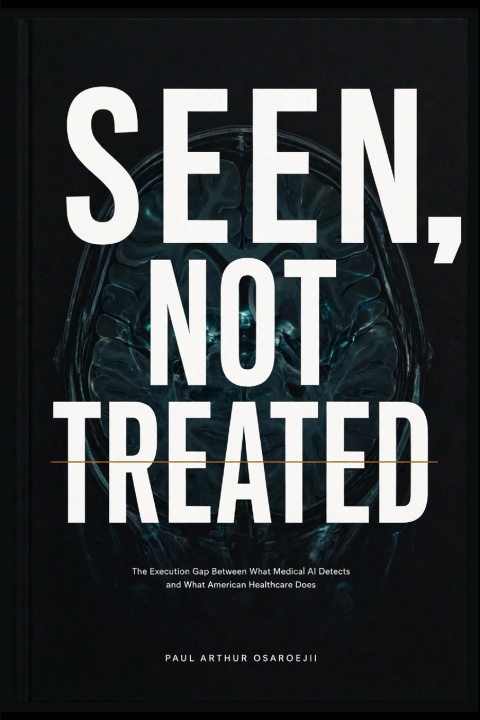
Seen, Not Treated
The Execution Gap Between What Medical AI Detects and What American Healthcare Does
 Angličtina
 90 b
 Pripravujeme
 Nové
Až 30 dní na vrátenie tovaru

The machine can see. The system cannot act.
Medical artificial intelligence has crossed the accuracy threshold. In controlled studies, algorithms now match or exceed specialist performance at reading radiographs, retinal photographs, pathology slides, skin lesions, and mammograms. Yet patients across the United States are still diagnosed late, diagnosed unequally, or not diagnosed at all.
The failure is not a knowledge failure, and it is no longer a technology failure. It is an execution failure. Findings go unrouted, screening loops stay open, tools are validated on one population and deployed on another, and proven systems sit unused at the clinic door.
In Seen, Not Treated, health services researcher Paul Arthur Osaroejii documents the evidence for the seeing and the evidence for the failure, and sets out the operating discipline that closes the distance between them, grounded in the CFIR and RE-AIM implementation frameworks and in more than 150 verified sources.
Inside the book:
• Part I. The Seeing: how machines learned to read medical images
• Part II. The Reading Body: radiology, pathology, dermatology, ophthalmology, cardiology, and cancer screening
• Part III. The Screening Promise: detection at population scale, and what it costs
• Part IV. The Accuracy Gap: bias, representation, and silent failure
• Part V. The Locked Door: regulation, privacy, liability, and implementation
• Part VI. The Operating System: closing the loop from finding to action
Written for health services researchers, health informatics faculty and students, clinical leaders responsible for AI adoption, and policy readers concerned with equity in medical algorithms.


Informácie o knihe
Angličtina

Darujte túto knihu ešte dnes
Je to jednoduché
1 Pridajte knihu do košíka a vyberte možnosť doručiť ako darček 2 Obratom Vám zašleme poukaz 3 Knihu zašleme na adresu obdarovanéhoAhoj! Som Libroamiko, tvoj knižný radca.
Ako ti môžem pomôcť?