
 Kontakt
 Ako nakupovať
Doručenie
Nákupný poradca
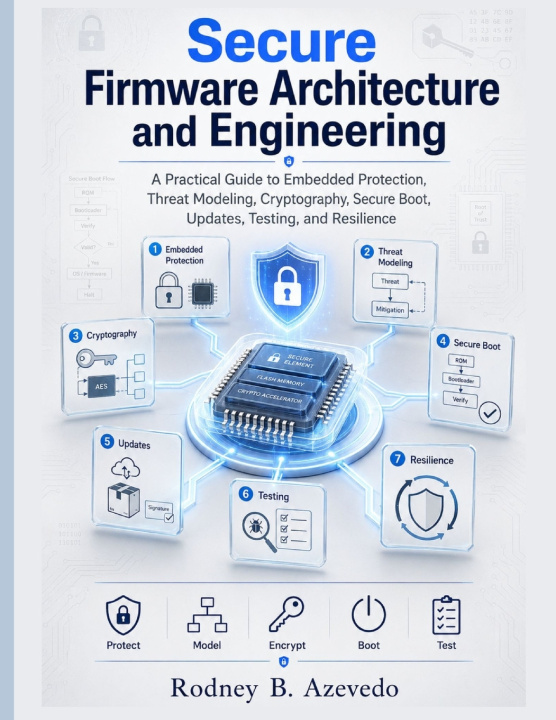
Secure Firmware Architecture and Engineering
A Practical Guide to Embedded Protection, Threat Modeling, Cryptography, Secure Boot, Updates, Testing, and Resilience
 Angličtina
 50 b
50 b
 Pripravujeme
 Nové
Nové
Až 30 dní na vrátenie tovaru

Have you ever wondered what actually happens in the split second between pressing a device's power button and it coming fully online - and how much trust gets quietly handed out in that window without anyone questioning it?
If you work anywhere near embedded systems, you already know the uncomfortable truth: firmware is the layer everyone assumes is secure and almost nobody actually verifies. It sits beneath the operating system, beneath the apps, beneath every antivirus tool and network monitor - and if it's compromised, everything built on top of it is compromised too, whether anyone notices or not. So here's the real question this book asks you to sit with: if someone extracted your firmware right now, decompiled it, and had a week to study it, what would they find?
This book was written for the engineers, architects, and technical leads who'd rather find out the hard questions themselves than have an attacker find them first.
It starts where most firmware security conversations skip past - the actual architecture of embedded hardware, how trust boundaries form (and quietly break) between components, and why memory types like flash, RAM, and one-time-programmable storage each carry their own very different security assumptions. From there, it walks step by step into threat modeling built specifically for firmware rather than borrowed awkwardly from web application security, showing you how to map data flows, draw trust boundaries, and build attack trees that actually reflect how embedded devices get attacked in the real world - physically, remotely, and through the supply chain.
From there, things get technical in the way this topic actually demands. You'll work through hardware roots of trust and secure enclaves, applied cryptography sized correctly for constrained devices, and a full, practical breakdown of secure boot architecture - chain of trust, signature verification, anti-rollback protection, and the specific ways real-world implementations have been bypassed, glitched, and quietly defeated. Firmware update systems get the same treatment: atomic update strategies, rollback protection, delta updates for bandwidth-starved devices, and how to keep a fleet of deployed units from bricking the moment power drops mid-update.
Somewhere around here, you might start asking yourself a different question: not "is my firmware secure," but "can I actually prove it is?" That's exactly where the book heads next - memory safety and exploit mitigation, side-channel and fault-injection resistance, reverse engineering awareness (because understanding how attackers actually extract and analyze firmware changes how you defend it), and a full security testing methodology covering static analysis, fuzzing, penetration testing, and hardware-in-the-loop validation.
And because this field doesn't sit still, the book closes by looking forward - toward AI-assisted anomaly detection running directly on constrained hardware, zero-trust thinking applied to device fleets instead of just enterprise networks, and the very real, very practical question of how to prepare firmware today for algorithms that don't fully exist in mainstream use yet, for devices that might still be running in the field fifteen years from now.
Every chapter pairs concept with practice - diagrams, workflows, code-level examples, and a genuine case study threaded through the book so you can watch a single device go from blank threat model to fully hardened, tested, field-ready firmware.
So - one more question before you decide whether this book belongs on your shelf: are you building firmware that merely works, or firmware you'd trust enough to stake your name on if someone took it apart tomorrow?
If that question makes you a little uneasy, good. That's exactly the instinct this book is written to sharpen.


Informácie o knihe
Angličtina

Darujte túto knihu ešte dnes
Je to jednoduché
1 Pridajte knihu do košíka a vyberte možnosť doručiť ako darček 2 Obratom Vám zašleme poukaz 3 Knihu zašleme na adresu obdarovanéhoAhoj! Som Libroamiko, tvoj knižný radca.
Ako ti môžem pomôcť?