
 Kontakt
 Ako nakupovať
Doručenie
Nákupný poradca
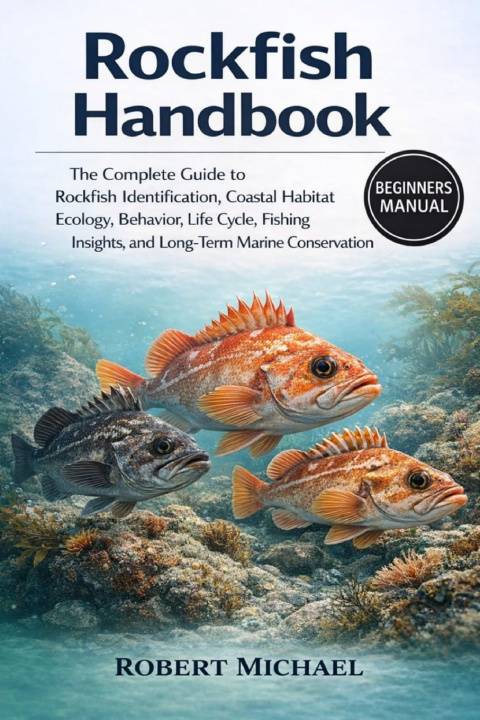
ROCKFISH HANDBOOK
The Complete Guide to Rockfish Identification, Coastal Habitat Ecology, Behavior, Life Cycle, Fishing Insights, and Long-Term Marine Conservation
 Angličtina
 55 b
55 b
Až 30 dní na vrátenie tovaru

INTRODUCTION
What Are Rockfish
Rockfish are a remarkable group of marine fishes belonging primarily to the genus Sebastes, a name that comes from the Greek word meaning "magnificent." The title is fitting. With their vivid colors, pronounced spines, large eyes, and solid, almost armored appearance, rockfish have a commanding presence in the waters they inhabit. Found mainly in the North Pacific Ocean, especially along the western coasts of North America and parts of Asia, rockfish occupy rocky reefs, kelp forests, and deep offshore environments where structure defines survival.
Unlike many fish that move in open water, rockfish are strongly associated with physical habitat. They hover close to rock outcrops, crevices, submarine ledges, and coral formations. Their very name reflects this relationship. The rocks are not simply scenery; they are shelter, feeding ground, ambush site, and nursery space all in one. The structural complexity of these habitats allows rockfish to blend into shadows and wait patiently for prey.
The group known as rockfish includes dozens upon dozens of species, each with subtle differences in color, size, depth preference, and behavior. Some species glow in bright vermilion red, others display mottled browns and olives, while a few appear nearly black in deep waters where sunlight barely penetrates. This diversity within a single genus makes rockfish one of the most fascinating marine fish groups in temperate oceans.
A Lineage Built for Depth
One of the most striking features of rockfish is their ability to inhabit a wide range of depths. Some species live in relatively shallow waters among kelp forests, while others dwell hundreds of meters below the surface in cold, dimly lit zones. Depth is not a trivial factor in the ocean. As depth increases, pressure intensifies, light fades, and temperature drops. Many fish species are limited by these conditions, but rockfish have evolved physiological traits that allow them to thrive across these gradients.
Their large eyes, particularly in deeper species, are adaptations for capturing faint light. Their sturdy bodies and specialized swim bladders help them maintain position in water columns where pressure differences are extreme. This depth flexibility has allowed rockfish to spread across vast continental shelves and slopes, occupying ecological niches that many other fish cannot.
Exceptional Longevity
Perhaps the most extraordinary characteristic that sets rockfish apart from many other ocean species is their lifespan. While most marine fish live for a few years or perhaps a couple of decades, some rockfish species can live well beyond a century. A few documented individuals have surpassed two hundred years of age. Such longevity is rare among fish and even rare among vertebrates as a whole.
Long life brings both advantages and vulnerabilities. On one hand, it allows individuals to reproduce many times across decades, contributing steadily to population stability when environmental conditions remain favorable. On the other hand, slow growth and late maturity mean that populations recover slowly if depleted. This combination of traits makes rockfish biologically unique and ecologically significant. They are not fast-turnover species. They are long-term residents of the marine environment, living witnesses to changes in ocean conditions across generations of people.
The study of rockfish longevity has fascinated marine scientists for decades. Their age is often determined by examining growth rings in ear bones called otoliths, much like counting rings in a tree trunk. These rings reveal life histories that stretch across centuries, offering valuable insights into ocean health and climate patterns over long time scales.
.


Informácie o knihe
Angličtina

Darujte túto knihu ešte dnes
Je to jednoduché
1 Pridajte knihu do košíka a vyberte možnosť doručiť ako darček 2 Obratom Vám zašleme poukaz 3 Knihu zašleme na adresu obdarovanéhoAhoj! Som Libroamiko, tvoj knižný radca.
Ako ti môžem pomôcť?