
 Kontakt
 Ako nakupovať
Doručenie
Nákupný poradca
 Angličtina
 24 b
24 b
Až 30 dní na vrátenie tovaru

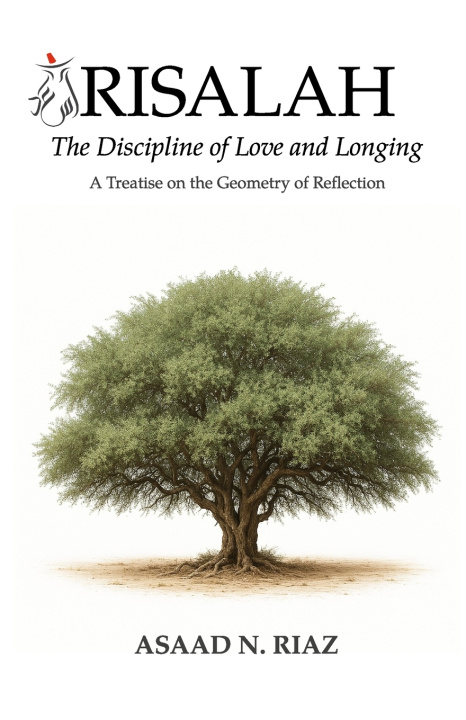
RISALAH: The Discipline of Love and Longing is not a manual for escape, but a map for those who burn.
Risalah is a meditation at the frontier where philosophy becomes devotion and devotion knowledge. It begins not with theory but with ache: What is the nature of love that annihilates the self yet preserves distinction? It asks the oldest of questions and answers not through abstraction, but through fire.
Authored by Asaad N. Riaz, a fakeer who writes from the ash of his own endurance, this treatise unfolds as a mirror for the soul already walking the path. Composed in Madinah, at the threshold of the Prophet's ﷺ Rawdah, it is not theology but unveiling; not speculation but remembrance. Each reflection reconciles intellect and love as twin movements of the same Light. It is for the seeker who feels the fire of Ishq (Love) yet searches for Mizan (Proportion) within that fire.
The book rests on one principle: The Prophet (ﷺ) is the "geometry of reflection," the only mirror in which Divine Light is seen without distortion.
Here, fana (annihilation) is not negation but purification-the clearing of distortion until only the Beloved's pattern remains. The self is not destroyed but sanctified. In the Prophetic path, love reaches perfection as servanthood: the highest station is not the lover but the slave. "Glory be to Him who took His slave by night." In that verse lies the secret of ascension-nearness belongs to surrender.
Drawing upon Ghazali, Iqbal, Attar, Rumi, and Hallaj, it weaves reason and revelation into one rhythm, until obedience becomes intimacy and the self, made transparent, becomes a perfect reflection of the Light. The intellect, when disciplined by love, becomes luminous; love, when guided by law, becomes eternal. Between them lies the Sirat-the middle path where thought bows without losing clarity, and love burns without consuming proportion.
It speaks of Wahdat al-Wujud and Wahdat al-Shuhud-of the cosmos as infinite expressions within the unity of One. Multiplicity, it shows, is not a fracture of tawhid but its radiance.
This work is not for the curious but for the called: for those who have tasted nearness and awoken to its withdrawal, for whom prayer has become endurance. It teaches that the dryness of faith is not absence but refinement: when worship persists without reward, and love stands free of transaction.
It charts the path from longing to alignment.
- THE FIRE AND THE FRAME: Why Divine Law (Shari'ah) is not a cage for love but the frame of reality-the sacred physics that converts the heat of ecstasy into the coherence of light.
- FROM LOVE TO SERVANTHOOD: The journey from fana (annihilation) to baqa (subsistence). It argues that the highest station is not "lover" but abd (slave), for proximity is granted to surrender.
- THE SOBER AND THE ECSTATIC: The narrow path between the safety of Junayd and the perilous unveiling of Hallaj, both contained within the balanced model of the Prophet (ﷺ).
- THE VALLEY OF DRYNESS: When sweetness departs and prayer becomes endurance-this is not absence but purification, the polishing of the mirror that reflects the Real.
- THE FINAL PERIL: Beware the subtle pride that mistakes borrowed light for its own.
At its core it is both confession and invocation: a philosopher's logic tempered by a lover's flame. It invites the reader to walk the razor's edge of proportion-to unite aql and ishq, reflection and remembrance, shari'ah and haqiqah. For every atom remembers, every law is mercy, and every path, if rightly walked, ends at the feet of the Messenger of Allah ﷺ-the still point where all multiplicity returns to Light.


Informácie o knihe
Angličtina
