
 Kontakt
 Ako nakupovať

Doručenie
Nákupný poradca
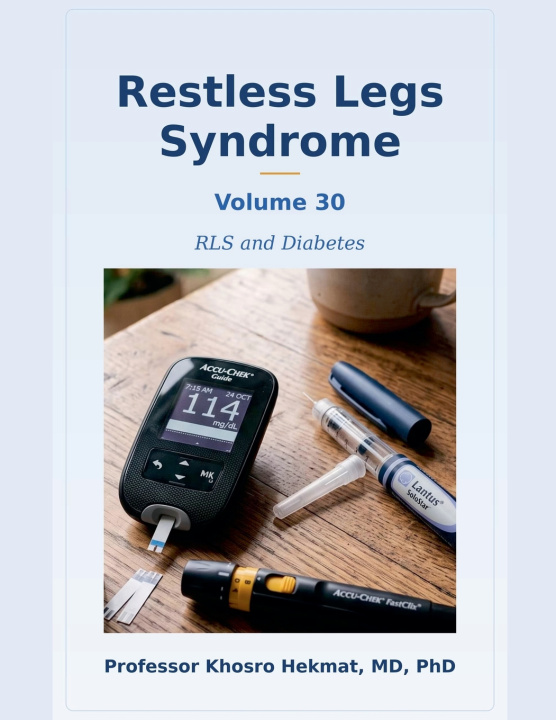
Restless Legs Syndrome - RLS and Diabetes
 Angličtina
 95 b
 Pripravujeme
 Nové
Až 30 dní na vrátenie tovaru

Two conditions, one pair of legs.
"My legs are restless in the evening, I cannot stay lying down." In diabetes clinics the answer is often the same: that is the nerve damage from the sugar. The patient then gets nothing, or a painkiller. Yet two conditions affect the same legs at the same hours of the day, sound almost identical in patients' descriptions, often occur together, and are treated differently.
A synthesis of 42 studies with 835,986 participants found signs of restless legs syndrome in 25 per cent of people with diabetes, almost double the risk of people without diabetes. The central study of this volume shows how much depends on the questioning. Of 199 people with diabetic nerve damage, 44 met the four questionnaire questions. After a structured interview and assessment by two neurologists, 16 remained. In a control group with knee osteoarthritis the number did not change. This is why figures in the literature range from 8 to 45 per cent.
The book sets out four features that separate restless legs syndrome from diabetic nerve damage: the urge to move, relief through movement, the pattern over the day and the time course. It asks whether the cause is the sugar, the nerves or something else, and finds nerve damage the best-documented link, while an association with the HbA1c value has not been demonstrated. A large genetic analysis now points to a direction from restless legs towards type 2 diabetes, a lead rather than a proof. Weight and insulin resistance, gestational diabetes, the kidneys and the three sleep disorders common in diabetes each have a chapter.
Treatment begins with two laboratory values that appear on no standard diabetes request: ferritin and transferrin saturation. In a randomised study of 209 patients, an iron infusion lowered the IRLS score by 8.0 points, against 4.8 under sham treatment. The book explains why the alpha-2-delta ligands act on both the restlessness and neuropathic pain, what applies with kidney damage, and which medicines can make the legs worse, among them mirtazapine, which worsened restless legs in 28 per cent.
It ends with a plan for your next appointment: measure restlessness, pain and sleep separately, use the self-administered version of the IRLS scale, and decide in advance what should have changed after twelve weeks.
WHAT IS IN THE BOOK
- Why restless legs syndrome and diabetes have to be considered together
- The five diagnostic criteria and the most important mimics in diabetes
- Thick and thin nerve fibres, and what the standard examination misses
- Four features that separate restless legs from diabetic nerve damage
- Why the prevalence figures range from 8 to 45 per cent
- Is it the sugar, the nerves, or something else entirely?
- Weight, insulin resistance, muscle mass and gestational diabetes
- The night: three sleep disorders in one bed, and what poor sleep does to blood glucose
- Pain, the kidneys, the heart and quality of life
- Iron first, then the medicines, with what to watch for in diabetes
- What makes restless legs worse
- Exercise, your own plan and the conversation with your doctor
WHO THIS BOOK IS FOR
For people with diabetes and night-time leg symptoms, for everyone diagnosed with polyneuropathy whose treatment is not working, and for health professionals in diabetes care.
ABOUT THE SERIES
Volume 30 of 52 in the book series on restless legs syndrome, part "RLS with Other Conditions". Every volume can be read on its own. The statements in this volume rest on 173 professional sources, each one listed individually in the reference section.


Informácie o knihe
Angličtina

Darujte túto knihu ešte dnes
Je to jednoduché
1 Pridajte knihu do košíka a vyberte možnosť doručiť ako darček 2 Obratom Vám zašleme poukaz 3 Knihu zašleme na adresu obdarovanéhoAhoj! Som Libroamiko, tvoj knižný radca.
Ako ti môžem pomôcť?