
 Kontakt
 Ako nakupovať
Doručenie
Nákupný poradca
 Angličtina
 28 b
28 b
30 dní na vrátenie tovaru

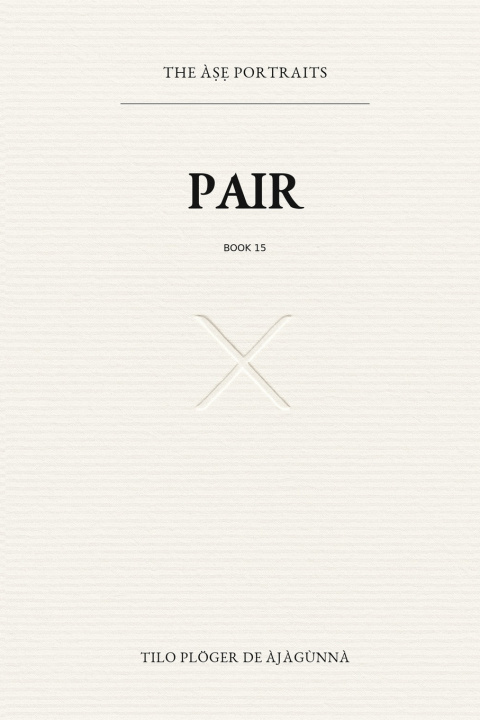
PAIR
A novel about a game of two that quietly rewrites the rules for everyone else.
In a schoolyard where everything comes in twos-twins, shared vapes, benches that only make sense with two sets of knees-Lina and the unnamed narrator invent a game to keep from being swallowed by the rules. What begins as chalk squares and private signals turns into a system that decides who is allowed to be "fine," who is marked as excessive, and who is quietly left out of the frame.
PAIR is a sharply attentive coming-of-age novel in which joy behaves like contraband. Every party, every after-school transit, every mirrored selfie becomes evidence in an unspoken trial: are you manageable enough to belong? As the term advances, the game shifts from play to doctrine. Pairings are encouraged, then audited. Teachers learn to quote the game back at the students. The yard's invisible grid starts to feel like a theology in which only certain bodies are considered legible.
Told in a first-person voice that stays close, bright, and knife-clean even when grief arrives without warning, PAIR traces how adolescence and administration collude to split a person in two: the self who laughs and the self who is watched. For readers of Carmen Maria Machado, Ottessa Moshfegh, and Rachel Cusk, this book bends the "school novel" into a tense, formally precise meditation on how we abandon pieces of ourselves just to be treated as functional.
Inside the hidden architecture of the series, PAIR moves in the orbit of the Òrìṣà Ìbejì - the divine twins of the Yorùbá and Ifá tradition - and is tuned to the Odù Òṣé. Their presence is never named, but it hums in the rule of two: mirrored scenes, twin chapters, choices that split the protagonist's life down an invisible line. Àṣẹ appears as the force that turns a child's game into a social law and then asks what is lost when joy is treated as a problem to be solved.
Perfect for readers who appreciate:
• Literary coming-of-age stories with a formal twist
• School, friendship, and queer subtext rendered with unsentimental clarity
• Subtle threads of Orisha/Ifá cosmology without explanatory detours
• Books that ask what it costs to appear "normal" in public
PAIR is Book 15 in THE ÀṢẸ PORTRAITS, a 17-volume cycle where each novel is tuned to a specific Odù Ifá and Òrìṣà current - city-set, formally daring, spiritually charged but never didactic.


Informácie o knihe
Angličtina
