
 Kontakt
 Ako nakupovať
Doručenie
Nákupný poradca
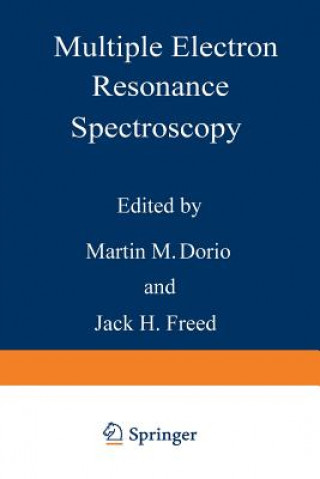
Multiple Electron Resonance Spectroscopy
 Angličtina
 125 b
125 b
Až 30 dní na vrátenie tovaru
Zákazníci tiež kúpili













 /
/
 Brožovaná
 40.53
€
40.53
€




 /
Brožovaná
52.93
€
/
Brožovaná
52.93
€



Abragam and Bleaney/H) and others.o6---19) Basically, this volume deals with those spectroscopic techniques that use EPR as a detection method. Chapters 2 through 5 cover the experimental and theoretical aspects of multiple resonance spectroscopy. Chapters 6 through 12 are systems-oriented and deal with the multiple resonance techniques applied to crystals, glasses, bioproteins, polymers, and triplets. The concepts of the first five chapters illustrate the strength of MERS to solve a broad range of problems. Chapters 13 and 14 are rather detailed introductions to two of the latest new applications: TRIPLE resonance and optical perturbations in EPR. The latter is to be distinguished from the OMDR (optical magnetic double resonance) techniques, in which the optical system is the detection method. References 1. E. J. Zavoisky, J. Phys. U.S.S.R. 9, 211 (1945). 2. J. S. Hyde, Ann. Rev. Phys. Chern. 25, 407 (1974). 3. N. M. Atherton, Electron Spin Resonance (Specialist Periodical Reports, The Chemical Society, London) 1, 32 (1972); 2, 35 (1974). 4. J. H. Freed, Ann. Rev. Phys. Chern. 23, 265 (1972). 5. J. E. Wertz and J. R. Bolton, Electron Spin Resonance, Elementary Theory and Practical Applications, p. xii, McGraw-Hill Book Co., New York (1972). 6. G. Feher, Phys. Rev. 103,834 (1956). 7. P. P. Sorokin, G. J. Lasher, and I. L. Gelles, Phys. Rev. 118, 939 (1960). 8. N. Bloembergen, S. Shapiro, P. S. Pershan, and J. O. Artman, Phys. Rev. 114,445 (1959).


Informácie o knihe
Angličtina

Darujte túto knihu ešte dnes
Je to jednoduché
1 Pridajte knihu do košíka a vyberte možnosť doručiť ako darček 2 Obratom Vám zašleme poukaz 3 Knihu zašleme na adresu obdarovanéhoMohlo by vás tiež zaujímať
 /
Brožovaná
17.23
€
/
Brožovaná
17.23
€







 /
Brožovaná
38.11
€
/
Brožovaná
38.11
€















Ahoj! Som Libroamiko, tvoj knižný radca.
Ako ti môžem pomôcť?