
 Kontakt
 Ako nakupovať

Doručenie
Nákupný poradca
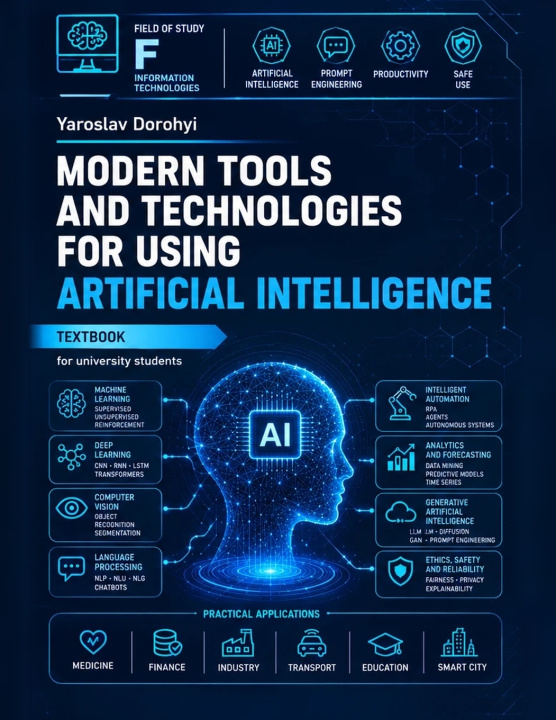
Modern Tools and Technologies for Using Artificial Intelligence
 Angličtina
 81 b
 Pripravujeme
 Nové
Až 30 dní na vrátenie tovaru

A rigorous, research-oriented guide to the methods and tools of modern artificial intelligence - from knowledge representation and search to transformers, large language models, explainable AI and swarm metaheuristics.
Written for doctoral and master's students in computer science and information technology, and for researchers who use AI in their own work, this textbook combines solid theory, the mathematics behind each method, and working Python code. Each method is explained, written down formally, illustrated and then applied.
The book follows a single running example: Eureka, an intelligent research-assistant system. It gains a new capability in every chapter, from a knowledge base and expert rules to neural recognition modules, an agent swarm and a generative reviewing assistant. Separate methods come together as one coherent architecture.
What you will learn
- Classical AI: logical, production, frame and semantic-network models of knowledge; predicate-logic semantics and unification; BFS, DFS, A* and IDA*; ontologies, OWL and description logic with the tableau algorithm; expert systems and Bayesian networks.
- Learning and soft computing: genetic algorithms and fitness landscapes; neural networks from the perceptron to CNNs, LSTMs and transformers; fuzzy inference, Mamdani and Sugeno models, ANFIS; pattern recognition with kNN, SVM, PCA, decision trees and ensembles.
- Agents and collective intelligence: rational agents, MDPs, Q-learning, value and policy iteration; ant colony and particle swarm optimisation; multi-agent systems and consensus.
- Modern topics: clustering and dimensionality reduction (k-means, DBSCAN, HDBSCAN, t-SNE, UMAP).
- Research practice: rigorous evaluation (cross-validation, data leakage, significance tests, bootstrap intervals, effect sizes); trustworthy and explainable AI (LIME, SHAP, Grad-CAM, fairness metrics, EU AI Act).
- Generative AI: large language models, prompt engineering, RAG, LoRA, RLHF, LLM agents, VAEs, GANs and diffusion models.
- Metaheuristics: grey wolf, whale, firefly, bat, cuckoo and bee colony optimisers.
Inside the book
- 16 chapters in two parts, each with learning outcomes, conclusions, key terms, self-check questions and graded exercises (basic and advanced)
- 127 figures and 52 tables that make algorithms and architectures easy to follow
- Advanced sections on the mathematical apparatus: Bellman equations, the dual SVM problem, Shapley values, replicator dynamics, the attention mechanism and more
- 15 practical assignments, a comparative overview of AI paradigms, and a guide to Python tools and research reproducibility
- Full solutions to 19 typical problems
- Companion Python programs for every chapter, plus Claude API examples for LLM agents
- 118 references and a subject index
Who this book is for
Doctoral and master's students in computer science and IT, researchers who apply AI methods in their dissertations and projects, and university lecturers who need a structured course that ranges from foundations to current practice. Material marked as advanced can be skipped on a first reading.
Learn not only how AI methods work, but how to choose, combine, evaluate and explain them in real research.


Informácie o knihe
Angličtina

Darujte túto knihu ešte dnes
Je to jednoduché
1 Pridajte knihu do košíka a vyberte možnosť doručiť ako darček 2 Obratom Vám zašleme poukaz 3 Knihu zašleme na adresu obdarovanéhoAhoj! Som Libroamiko, tvoj knižný radca.
Ako ti môžem pomôcť?