
 Kontakt
 Ako nakupovať
Doručenie
Nákupný poradca
 Angličtina
 65 b
65 b
 Nové
Nové
Až 30 dní na vrátenie tovaru

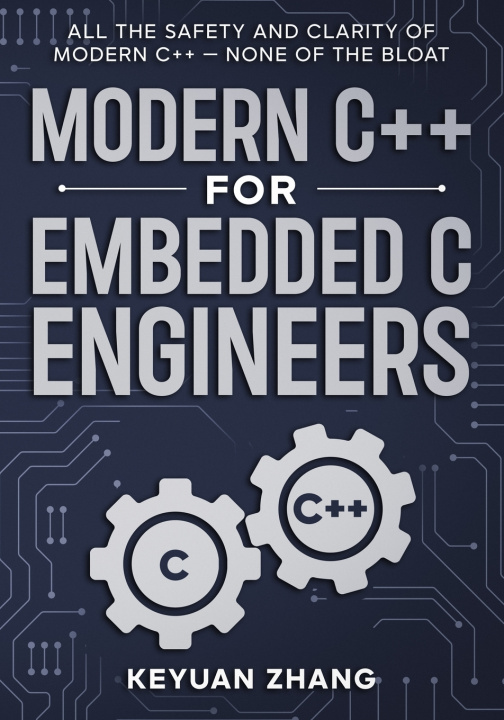
Modern C++ for Embedded C Engineers: The Strategic Bridge to the Future
Is your legacy C codebase a reliable asset or a "sleeping bomb" waiting to explode?
Industry data reveals a sobering reality: 70% of all critical security vulnerabilities are rooted in memory-safety failures inherent to traditional C. Furthermore, over 60% of engineering bandwidth is consumed by the "Maintenance Tax"-keeping brittle legacy systems on life support instead of innovating.
For organizations scaling into Autonomous Vehicles, AI-integrated IoT, and AR/VR, the transition to Modern C++ is no longer optional-it is a requirement for survival.
Defuse the Risk Without the BloatMany engineers avoid C++ due to fears of code-size bloat and execution penalties. This book provides the architectural proof that you can achieve Zero-Cost Safety. Written by a 30-year veteran software engineer and architect (Meta, Intel, Nortel Networks, BlackBerry, ABB), this guide demonstrates how to leverage Modern C++ as a high-performance abstraction layer that integrates seamlessly with your existing C codebases.
Inside this book, you will master:
RAII & Resource Management: Eliminate memory leaks by design without runtime overhead.
The Zero-Cost Philosophy: Use abstractions as fast as hand-written C but far safer.
Abstraction without Bloat: Move runtime execution to compile-time using templates and constexpr.
Compile-Time Power: Shrink binaries using LTO and LTCG.
Deterministic Safety: Outperform traditional C designs using std::span and move semantics.
Hybrid Mode: Protect your investment by combining Modern C++ with legacy C APIs.
High-Performance Infrastructure: Deep dives into RDMA, Smart NIC, and DPDK for cloud networking.
Why This Book?
While Python dominates the AI "frontend," the engines-TensorFlow, PyTorch, and llama.cpp-are built on C++. As hardware becomes more software-defined, the gap between legacy C and Modern C++ is closing. Mastery of these skills creates a professional "moat" around your career. In an era of AI automation, the ability to optimize under extreme hardware constraints is the ultimate job security.
About the AuthorAn experienced software engineer and architect with 30 years of experience at industry leaders including Meta, Intel, Nortel Networks, BlackBerry and ABB. Holding degrees from Tsinghua University, China's premier engineering institution, and the University of Texas at El Paso, the author provides a battle-tested roadmap for building the secure, scalable "Digital Nervous System" of the future.
Stop managing legacy risks. Start engineering for the next decade. Upgrade your codebase today.


Informácie o knihe
Angličtina
