
 Kontakt
 Ako nakupovať
Doručenie
Nákupný poradca
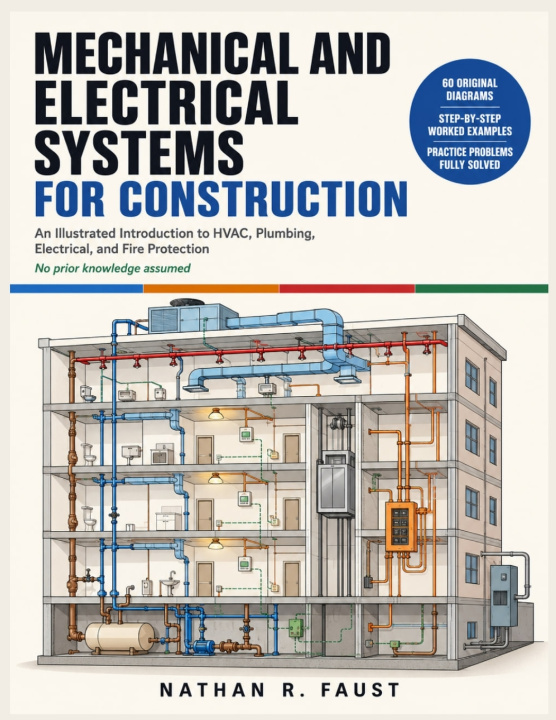
Mechanical and Electrical Systems for Construction
An Illustrated Introduction to HVAC, Plumbing, Electrical, and Fire Protection
 Angličtina
 199 b
199 b
 Nové
Nové
Až 30 dní na vrátenie tovaru

Every building has two lives. The one you can see: walls, glass, finished floors. And the hidden one that actually keeps it alive: the ducts, pipes, wires, sprinklers, and controls packed above every ceiling and behind every wall.
If you are studying construction management, architecture, or engineering, nobody hands you that hidden life gently. One week you are staring at your first MEP drawing set, a maze of symbols, line types, and abbreviations. The next, lectures and jobsites are moving in cfm, gpm, amps, and fixture counts, and everyone seems to assume you already speak the language.
Here is the uncomfortable truth: the gap does not close on its own. The standard textbooks in this field are brilliant but brutal: encyclopedic references written for engineers, a thousand pages deep, that explain everything except in an order a beginner can actually follow. So students memorize enough to survive the test and walk onto their first project still guessing. And on a real project, guessing about building systems is how budgets blow up, schedules slip, and credibility quietly drains away in every meeting where you nod along and hope nobody asks you a question.
Mechanical and Electrical Systems for Construction was written to close that gap properly, starting from zero.
This is a plain-language, genuinely beginner-first introduction to the systems that make buildings work. Every concept is explained in ordinary words before any formula appears. Every symbol is defined the first time it is used. Every calculation is worked through step by step with no skipped algebra. Nothing is assumed beyond basic math.
INSIDE THIS BOOK YOU WILL FIND:
• 15 chapters arranged in the order a student actually learns, from units and drawings to a capstone on coordinating all the systems in one building
• 60 original diagrams that show you what the words describe
• HVAC from first principles: heat, comfort, loads, furnaces, boilers, chillers, heat pumps, ducts, and hydronics
• Plumbing made logical: water supply and pressure, drainage, traps, venting, and stormwater
• Electrical without the fear: voltage, current, power, panels, circuits, breakers, grounding, and lighting
• Fire protection and life safety: detection, alarms, sprinklers, and how buildings get people out safely
• Elevators, escalators, and building automation, and how controls tie every system together
• Worked examples and practice problems with complete solutions, plus review questions with answers
• How to read MEP drawings, schedules, and specifications with confidence
• A quick-reference collection of every key formula in the book
• United States units and context throughout, with the role of US codes and standards explained in plain terms
WHO THIS BOOK IS FOR:
• First and second year construction management, architecture, and civil or construction engineering students
• Anyone entering the building industry who needs the systems demystified fast
• Readers with no prior knowledge and only basic algebra
AN HONEST NOTE ON SCOPE: This is an educational introduction and study companion, not a code book, design manual, or substitute for licensed professionals. It names the relevant US codes and explains what they do, but the codes themselves, and real design work, remain where they belong.
Buildings stop being mysterious the moment someone explains them properly. Scroll up and start understanding the hidden half of every building you will ever work on.


Informácie o knihe
Angličtina

Darujte túto knihu ešte dnes
Je to jednoduché
1 Pridajte knihu do košíka a vyberte možnosť doručiť ako darček 2 Obratom Vám zašleme poukaz 3 Knihu zašleme na adresu obdarovanéhoAhoj! Som Libroamiko, tvoj knižný radca.
Ako ti môžem pomôcť?