
 Kontakt
 Ako nakupovať
Doručenie
Nákupný poradca
 Angličtina
 45 b
45 b
 Nové
Nové
Až 30 dní na vrátenie tovaru

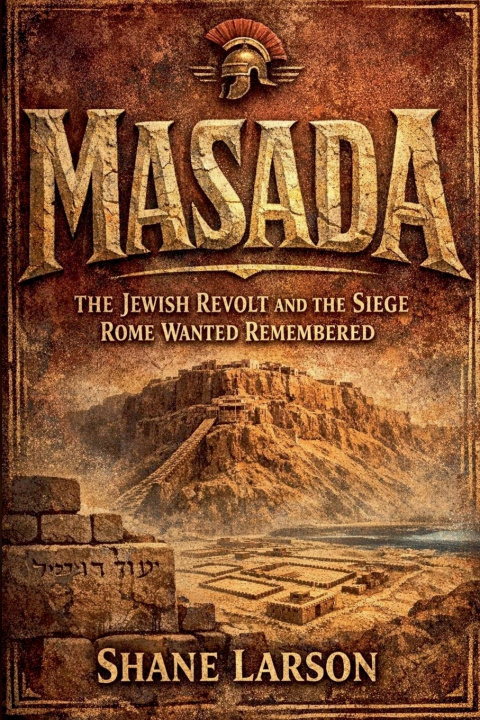
The Roman siege works are still there. Eight camps, a wall around an entire mountain, a ramp you can walk up - all of it measurable to the meter. The last stand rests on the word of one man.
Around AD 73, three years after the war was effectively over - Jerusalem taken, the Temple burned, the triumph already celebrated in Rome - the empire marched a legion across waterless desert to deal with a few hundred people on a rock they could not leave. It built fortified supply lines to a place with no food and no water, threw a two-mile wall around the whole mountain, laid out eight camps whose tent lines are still legible in the stones, and raised a siege ramp against the cliff. None of it was strictly necessary against an enemy with nowhere to go. Rome built it anyway, in a wilderness where almost no one would ever see the work. Sieges are messages as well as operations, and a good part of this book is spent working out what this one was meant to say.
What happened at the top of the ramp is another matter. Every word of it - the last night, the lots, the nine hundred and sixty dead - comes from Josephus: a rebel commander who surrendered at a previous siege, survived a suicide pact he himself proposed, prophesied that his captor would become emperor, took the emperor's family name when the prophecy paid off, and wrote the only account we have in Rome, under the patronage of the dynasty whose legion built the ramp. He was not there. And when archaeologists finally dug the site in the 1960s, the ground did not simply agree with him: roughly twenty-five to twenty-eight people were recovered from a site the story needs to have held nearly a thousand, and the storerooms the account requires to have been burned were found still holding provisions.
The shelf on this subject is polarized - the celebratory account on one side, the debunking on the other. This book is neither. It tells the story first, at full strength, the way it has been told for nineteen centuries: the impossible province, the paranoid king who built the fortress, the revolt, the war, the siege. Then it turns the whole thing over and tests it against the ground. Where the evidence supports a conclusion, it draws one. Where the evidence runs out, it says so plainly, and does not choose a version for you.
What you'll learn:
- Why Judaea was harder to govern than any other Roman province its size
- The fortress Herod built, and the water system - twelve rock-cut cisterns in a desert - that made a siege possible at all
- How the Tenth Legion solved a desert mountain: the logistics, the wall, and a ramp built on a natural spur in weeks, not years
- Who Josephus was, what he owed his patrons, and how to weigh a source who checks out on topography and inflates every crowd
- What the excavation found - palaces, scrolls, sherds inked with names - and what it conspicuously did not
- Every serious reconstruction of the final night, and exactly where the evidence stops
This book is for you if:
- You want the famous story and the evidence for it in the same book, not one or the other
- You read military history for the engineering and the logistics, not just the battle scenes
- You are suspicious of both the heroic version and the debunking
- You think "we do not know," said at the right moment, is worth more than a confident guess
A siege you can measure. A last stand you cannot. This is the book that is honest about the difference.


Informácie o knihe
Angličtina

Darujte túto knihu ešte dnes
Je to jednoduché
1 Pridajte knihu do košíka a vyberte možnosť doručiť ako darček 2 Obratom Vám zašleme poukaz 3 Knihu zašleme na adresu obdarovanéhoAhoj! Som Libroamiko, tvoj knižný radca.
Ako ti môžem pomôcť?