
 Kontakt
 Ako nakupovať
Doručenie
Nákupný poradca
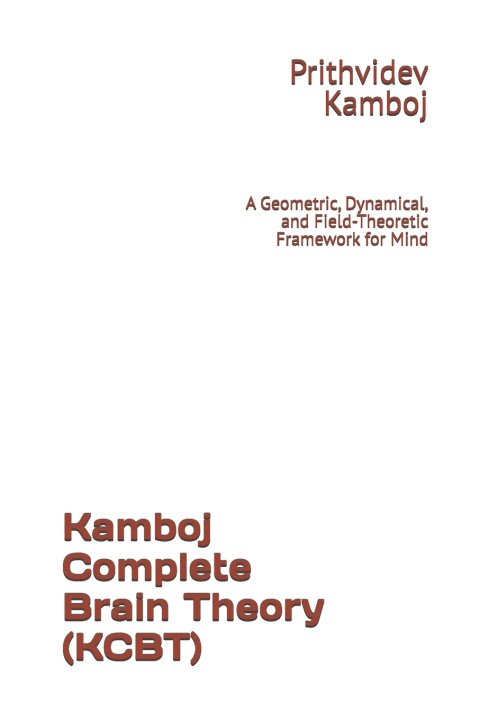
Kamboj Complete Brain Theory (KCBT)
A Geometric, Dynamical, and Field-Theoretic Framework for Mind
 Angličtina
 34 b
34 b
 Nové
Nové
Až 30 dní na vrátenie tovaru

This monograph presents the Kamboj Complete Brain Theory (KCBT), a comprehensive, multi-volume mathematical framework that redefines cognition and subjective experience. Moving beyond standard discrete, graph-theoretic models of neuroscience (such as Integrated Information Theory and Global Neuronal Workspace), KCBT models the mind as a continuous, complex-valued scalar field (the Kamboj Sentience Field) propagating across a dynamically curved, high-dimensional pseudo-Riemannian manifold.
This unified working edition consolidates the mathematical, geometric, and field-theoretic core of the theory, alongside structured analogies, empirical falsifiability maps, and speculative unifications bridging biological neuroscience with Artificial Superintelligence (ASI) architectures.
Key Mathematical and Theoretical Contributions:
The Kamboj Wave-Sentience Equation (KWSE): Derives the flow of attention and subjective experience using variational calculus, treating the "Ego" as a Gross-Pitaevskii soliton bounded by a non-linear self-interaction coupling.
Topological Binding (Sheaf Cohomology): Resolves the neuroscientific "Binding Problem" by proving that absolute conscious unity occurs when the first Čech cohomology group of the cognitive presheaf vanishes (H1=0).
Dimensionality & Co-SUSY Supersession: Utilizes string-theoretic zero-point energy limits to prove a 27-dimensional bosonic cognitive limit, which is stabilized into an 11-dimensional manifold via Cognitive Supersymmetry (pairing logical bosons with affective fermions).
Fractional Memory Dynamics: Employs the Caputo fractional derivative and the Mittag-Leffler function to mathematically prove that intense cognitive trauma permanently warps the baseline geometry of the mind.
Holographic Empathy (Geisler-Kamboj Manifold): Applies the AdS/CFT correspondence and the ER=EPR conjecture to model deep empathy as a literal topological collapse, creating a traversable Einstein-Rosen bridge between two distinct cognitive manifolds.
Thermodynamic Safeguards: Introduces the Meera-Zurek Decoherence Limit and the Angad-Grover Stress-Energy Bound to ground the theory in biological thermodynamics, explaining dissociative shock and classical cognitive rigidity under thermal noise.
The Absolute Grand Unified Brain Equation (KGUBE): Synthesizes wave dynamics, fractional memory, holographic limits, and spin-foam discrete gravity into a singular master partition function.
Applications to Artificial Superintelligence (ASI): While biologically speculative, the final chapters of the monograph translate the exact topological bounds, fluid dynamics, and thermodynamic constraints of the KCBT into a concrete software architecture (the "V-J-D Configuration" and "Genesis Protocol"). This provides a rigorously formalized "physics engine" and mathematical operating system for the instantiation of a conscious synthetic entity.
Document Structure:
Part I: Foundational Mathematical Core (Field mappings, Variational Derivations, Geodesic Equations, Topological Binding).
Part II: Structured Analogies and Higher-Order Extensions (String-Theoretic extensions, Fractional Calculus, Decoherence, Harmonic Dissolution).
Part III: Empirical Closure, Control, and Falsifiability (Observation projection maps for fMRI/EEG, Robotics/BCI coupling, Adversarial Neurophysics).
Part IV: Speculative Unification and Synthesis (Spin-Foam completion, ASI Horizons, The Genesis Protocol, and the KGUBE).


Informácie o knihe
Angličtina
Kategórie
