
 Kontakt
 Ako nakupovať
Doručenie
Nákupný poradca
 Angličtina
 53 b
53 b
 Nové
Nové
30 dní na vrátenie tovaru

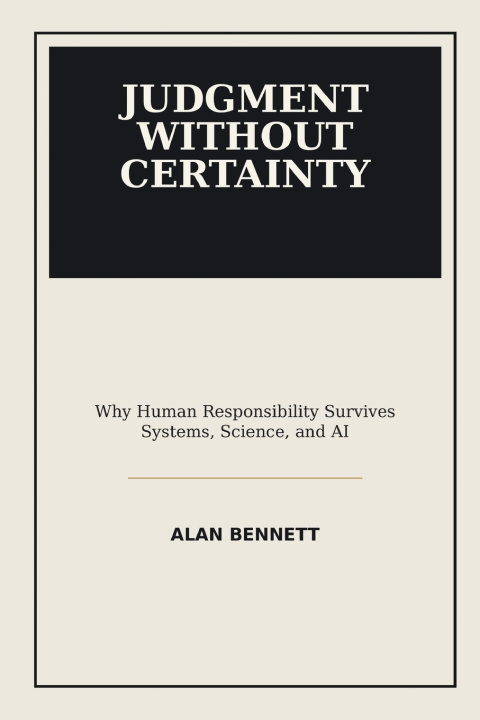
Judgment Without Certainty is a book about one of the most persistent conditions of human life: the need to decide before certainty is complete.
Alan Bennett begins with the ancient example of Socrates, whose wisdom lay not in possessing final knowledge, but in recognising the limits of what he knew. That insight becomes the starting point for a wide-ranging examination of judgment, responsibility and human decision making in a modern world overflowing with information, expertise, rules, models, systems and artificial intelligence.
The central argument of the book is that civilisation does not depend upon perfect certainty. It depends upon the continued exercise of responsible judgment where certainty is unavailable. Human beings must act, trust, decide, believe, doubt, commit and take responsibility long before all proof is complete. A patient accepts treatment without knowing the outcome. A judge decides despite incomplete evidence. A government acts on imperfect intelligence. A citizen votes without knowing the future. A person marries, forgives, trusts, risks and believes without final proof.
The book moves from ancient philosophy to modern institutional life. It examines why uncertainty frightens us, why false certainty becomes attractive, and why the limits of knowledge have troubled philosophers from Socrates, Plato and Aristotle to Hume, Kant and modern thinkers. It then considers perception, causation, memory, cognitive error, scientific uncertainty, legal proof, government decision making, faith, commitment, systems, prediction and artificial intelligence.
This is not a book against science, law, expertise, faith, systems or AI. Each has an important place. Science disciplines belief through evidence. Law makes public decision making possible. Faith addresses trust and commitment beyond proof. Systems assist organisation and consistency. Artificial intelligence can help identify patterns and support better decisions. The danger arises only when any of these is asked to do more than it can properly do.
Science cannot answer every question of value. Law cannot wait for absolute certainty. Faith cannot produce complete proof. Systems cannot abolish judgment. Prediction is not wisdom.
In an age increasingly shaped by digital systems, risk models, automated processes and artificial intelligence, the temptation is to believe that uncertainty can finally be eliminated by technique. More data, better models, stronger rules and faster systems may reduce uncertainty and assist judgment. But they cannot remove the human responsibility to decide what matters, what should be trusted, what should be done, and who must answer for the result.
Judgment Without Certainty argues that human judgment remains unavoidable because human life itself remains incomplete, contingent and only partly knowable. The task is not to escape judgment, but to understand it, discipline it and exercise it responsibly.
Written in clear and serious prose, the book will appeal to readers interested in philosophy, law, public life, science, artificial intelligence, religion, governance and the moral burden of decision making. It is both ancient and contemporary in its reach. It returns to Socrates and the classical problem of knowledge, while also addressing the modern pressures created by institutional systems, predictive technologies and the search for certainty in an uncertain world.
Its foundational question is simple but demanding: when certainty is incomplete and responsibility cannot be avoided, how should human beings judge?
The answer offered by this book is that responsible judgment requires humility without paralysis, confidence without arrogance, and courage without false certainty. Human beings cannot finally transfer responsibility to systems, experts, rules, models, institutions or doctrines. They must still judge. The question is whether they will do so wisely.


Informácie o knihe
Angličtina
