
 Kontakt
 Ako nakupovať
Doručenie
Nákupný poradca
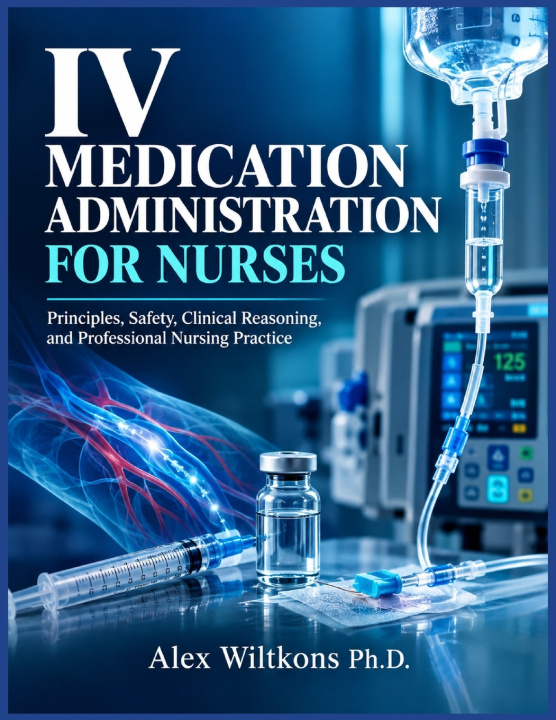
IV MEDICATION ADMINISTRATION FOR NURSES
Principles, Safety, Clinical Reasoning, and Professional Nursing Practice
 Angličtina
 292 b
292 b
 Nové
Nové
Až 30 dní na vrátenie tovaru

IV Medication Administration for Nurses
Principles, Safety, Clinical Reasoning, and Professional Nursing Practice
IV Medication Administration for Nurses is a comprehensive professional textbook designed to help nurses, nursing students, educators, and healthcare professionals develop a deeper understanding of safe, accurate, and clinically sound intravenous medication administration.
Intravenous medication administration is more than inserting an IV line and giving medication. It requires knowledge of pharmacology, vascular access, medication calculations, aseptic technique, compatibility, patient assessment, clinical judgment, monitoring, communication, and documentation. Because IV medications enter the bloodstream directly, accurate decision-making and careful attention to safety are essential.
This book brings these important areas together into one structured learning resource, connecting theory with practical nursing responsibilities and clinical reasoning.
What You Will Learn
- Foundations of IV medication administration and its role in professional nursing practice.
- Anatomy and physiology of the venous system, including considerations for different vascular-access options.
- Pharmacological principles relevant to intravenous medication therapy.
- Legal, ethical, and professional responsibilities surrounding medication administration.
- Core IV medication safety principles, including patient identification, allergy assessment, order verification, calculation checks, monitoring, and documentation.
- Peripheral IV, midline, extended-dwell, and central venous access considerations.
- Infusion equipment and systems, including safe management of IV therapy.
- Aseptic technique and infection-prevention principles.
- Medication preparation, reconstitution, dilution, labeling, compatibility, and administration considerations.
- IV medication calculations, with emphasis on accuracy and independent verification.
- IV push, intermittent, and continuous infusion administration.
- High-alert and high-risk medications and the additional safeguards they require.
- Antimicrobials, analgesics, sedatives, cardiovascular and vasoactive therapies, anticoagulants, insulin, and electrolyte infusions
Throughout the book, IV medication administration is presented as a complete clinical process-not simply a technical procedure. The emphasis is on assessing the patient, verifying the medication order, evaluating vascular access, preparing medications correctly, administering therapy safely, monitoring the patient's response, recognizing potential problems, communicating effectively, and documenting appropriately.
The book also emphasizes that nurses must work within their scope of practice, institutional policies, professional standards, prescribing information, and applicable regulations, while recognizing the importance of supervised competency and independent verification for clinical calculations.
Designed for Learning and Clinical Integration
The textbook is organized progressively, moving from foundational principles to vascular access, medication preparation and calculations, administration techniques, high-risk therapies, complications, special populations, clinical reasoning, and professional practice.
Its supporting resources include:
- Practical tables and structured learning material
- Medication calculation resources
- Compatibility and administration safety considerations
- Vascular-access selection and assessment guidance
- Complication assessment resources
- Monitoring and documentation checklists
- Glossary and index for quick reference


Informácie o knihe
Angličtina
Kategórie

Darujte túto knihu ešte dnes
Je to jednoduché
1 Pridajte knihu do košíka a vyberte možnosť doručiť ako darček 2 Obratom Vám zašleme poukaz 3 Knihu zašleme na adresu obdarovanéhoAhoj! Som Libroamiko, tvoj knižný radca.
Ako ti môžem pomôcť?