
 Kontakt
 Ako nakupovať
Doručenie
Nákupný poradca
 Angličtina
 136 b
136 b
 Nové
Nové
30 dní na vrátenie tovaru

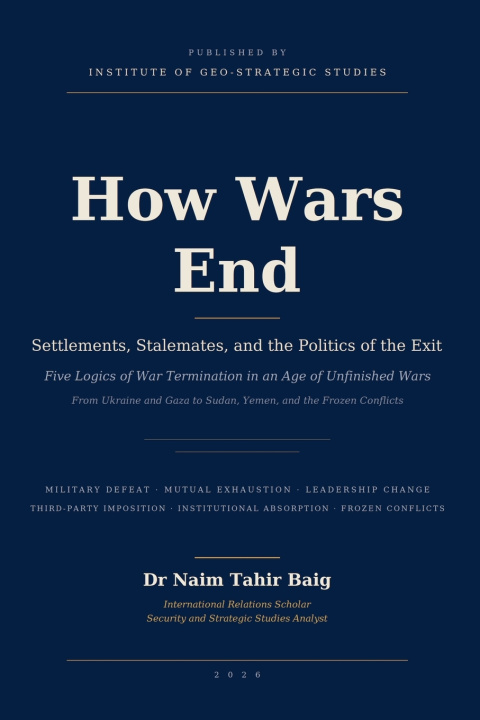
How Wars End
Settlements, Stalemates, and the Politics of the Exit
Dr Naim Tahir Baig,
About the Book
In the spring of 2026, the world confronts a constellation of unended wars unlike any since 1945. Ukraine has entered its fifth year of fighting. The Gaza ceasefire negotiated under American auspices in October 2025 has decayed into a violent middle condition that the existing vocabulary of conflict cannot precisely name. Sudan, partitioned between rival governments in Khartoum and Nyala, has crossed a thousand days of war and produced what the United Nations describes as the world's worst humanitarian catastrophe. A war between the United States, Israel, and Iran - launched on February 28, 2026 with the killing of Iran's supreme leader - has closed the Strait of Hormuz and reordered the geopolitics of the Gulf. Myanmar's military junta has consolidated power through elections the world's democratic monitors have uniformly rejected. And across this landscape of active wars sit the frozen ones - Korea, Cyprus, Kashmir, Transnistria, Taiwan, Western Sahara - some stable for half a century, others approaching the thaw that turns frozen conflicts into hot ones again.
How Wars End offers a framework for understanding this moment and the wars that have produced it. Its central claim is that every war whose ending can be analytically characterized in terms of political closure has done so through one, or some combination, of five mechanisms: military defeat, mutual exhaustion, leadership change, third-party imposition, and institutional absorption. Drawing on a literature stretching from Fred Iklé's foundational Every War Must End (1971) through I. William Zartman's ripeness theory, Hein Goemans's analysis of leadership exposure, and the most recent work on coalitional politics, mediation, and the political economy of conflict, the book builds an integrated framework that is then tested against the live wars of the mid-2020s and against a comparative dataset of historical terminations from Carthage to the present.
The argument advances in three parts. The first develops the theory, beginning with the long-standing asymmetry between the rich literature on how wars begin and the comparatively thin library on how they end. It then introduces the five-logic framework, treats each logic at chapter length, theorizes the cross-cutting role of leadership insulation in conflicts driven by war economies, and identifies how the five logics must be modified for asymmetric conflicts in which one party is a non-state actor. The second part applies the framework to live cases - Ukraine, Gaza and the Israel-Iran axis, Sudan, Yemen, Myanmar, and the world's principal frozen conflicts - using a diagnostic table that the book introduces and applies consistently. The third part draws the prescriptive conclusions: what states, mediators, and informed publics would do differently if they took termination as seriously as initiation.
For scholars of international relations and conflict studies, How Wars End offers the most ambitious integration of the termination literature since Reiter's How Wars End (2009), updated for a world that the existing scholarship was not designed to explain. For diplomats and mediators, it provides a diagnostic instrument - Appendix A's comparative termination table - that can be applied to any unended war to identify which logic is closest to operative, which preconditions are absent, and what would have to change.


Informácie o knihe
Angličtina
