
 Kontakt
 Ako nakupovať
Doručenie
Nákupný poradca
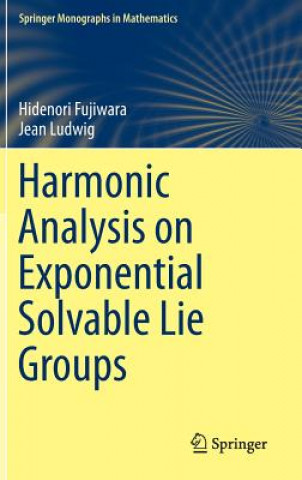
Harmonic Analysis on Exponential Solvable Lie Groups
 Angličtina
 265 b
265 b
30 dní na vrátenie tovaru
Zákazníci tiež kúpili








This book is the first one which gathers recent results on the harmonic analysis of exponential solvable Lie groups. There are many interesting open problems and the authors believe that this book contributes to the future progress of this research field. We present various topics related to each other which invite young researchers.§§The theory of unitary representations of these groups is based on the orbit method invented by Kirillov. We apply this method to study some basic problems in the analysis on exponential solvable Lie groups.§§Let G = exp be an exponential solvable Lie group with Lie algebra . This means that the exponential mapping exp is a diffeomorphism from onto G . Then, the unitary dual of G being the set of the equivalence classes of all irreducible unitary representations of G , the orbit method tells us that is realized as the space / G of the coadjoint orbits of G . This fact is built up using the Mackey theory for induced representations. We first explain this mechanism.§§One of the fundamental problems in the representation theory is the irreducible decomposition of the induced or restricted representations. We therefore study in detail these decompositions and then proceed to various related problems: multiplicity formula, Plancherel formulas, intertwining operators, Frobenius reciprocity and associated algebras of invariant differential operators.§As a matter of fact, the main reasoning in the proof of our assertions is the induction and we have not many tools in hand. So, the detailed analysis of our objects listed above is difficult even for exponential solvable Lie groups and we often assume that G is nilpotent.§§To make the situation more clear and a future development possible, we give many concrete examples. Various topics presented in the nilpotent case still have to be studied for solvable Lie groups which are not nilpotent. We believe that they all present interesting and important but difficult problems, which should be addressed in the near future.§§Beyond the exponential case, we need holomorphically induced representations introduced by Auslander and Kostant. This is the reason why we include them in this book.§


Informácie o knihe
Angličtina

Darujte túto knihu ešte dnes
Je to jednoduché
1 Pridajte knihu do košíka a vyberte možnosť doručiť ako darček 2 Obratom Vám zašleme poukaz 3 Knihu zašleme na adresu obdarovanéhoMohlo by vás tiež zaujímať



 /
/
 Pevná
Pevná
 79.04
€
79.04
€


Ahoj! Som Libroamiko, tvoj knižný radca.
Ako ti môžem pomôcť?