
 Kontakt
 Ako nakupovať
Doručenie
Nákupný poradca
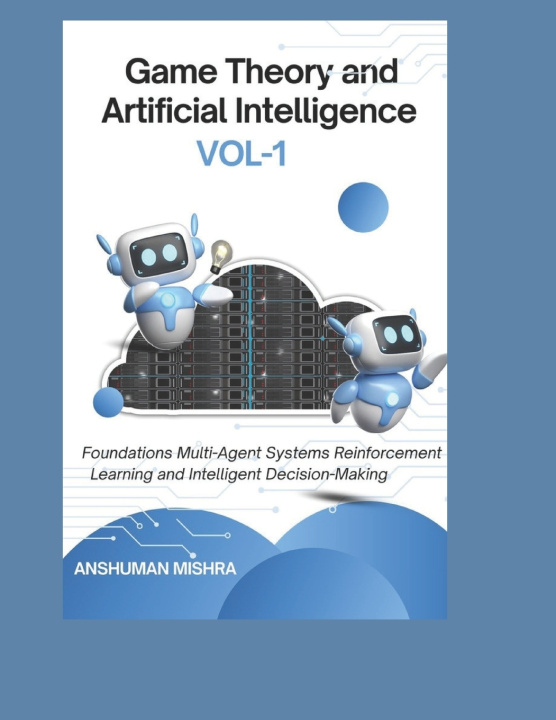
Game Theory and Artificial Intelligence
 Angličtina
 44 b
44 b
Až 30 dní na vrátenie tovaru

Human civilization has always been shaped by decision-making-whether in economics, politics, warfare, business, or social interaction. Yet, as we rapidly transition into a digital world powered by artificial intelligence, robotics, and autonomous systems, decision-making is no longer an exclusively human activity. Intelligent machines now negotiate, cooperate, compete, learn, adapt, and sometimes even make strategic choices that exceed human intuition. At the core of this emerging revolution lies a powerful, elegant, and interdisciplinary mathematical framework: Game Theory.
Game theory is not merely a branch of mathematics. It is a universal language of strategic interaction-a lens through which we can understand how independent decision-makers (called agents) behave when their goals conflict, align, or evolve. Artificial Intelligence (AI), meanwhile, is the science of building machines capable of perception, reasoning, and autonomous decision-making. The fusion of these two fields has created one of the most influential research and engineering domains of the 21st century: Game-Theoretic Artificial Intelligence.
This book, Game Theory and Artificial Intelligence: Foundations, Multi-Agent Systems, Reinforcement Learning, and Intelligent Decision-Making, written by Anshuman Mishra, serves as a comprehensive, deeply structured, and academically rigorous guide that connects classical game theory with cutting-edge AI technologies. Designed for undergraduate students, postgraduate learners, researchers, and industry professionals, this book blends conceptual depth with practical insights, ensuring that readers gain both theoretical mastery and functional understanding.
Why This Book Matters in Today's World
As AI systems increasingly interact with humans and with each other, they must operate intelligently in environments filled with uncertainty, competition, cooperation, and dynamic change. Autonomous vehicles negotiate merges. Trading bots compete in algorithmic financial markets. Cybersecurity systems anticipate attacker strategies. Multi-robot teams coordinate complex missions. Social networks influence collective human behavior. Reinforcement learning agents adapt through trial and error within changing environments. These interactions are not isolated-they are strategic. Game theory provides the foundation for building intelligent AI systems that can reason strategically, coordinate efficiently, and operate robustly in multi-agent environments.
Most existing textbooks treat game theory, reinforcement learning, Bayesian decision theory, and multi-agent systems as isolated subjects. However, real-world AI systems must synthesize these areas. This book bridges that gap by unifying:
- Classical and modern game theory
- Multi-agent system architectures
- Reinforcement learning and deep RL
- Mechanism design and strategic incentives
- Evolutionary dynamics and learning processes
- Practical applications in robotics, cybersecurity, economics, and AI governance
Core Features of This Book
1. A Structured Foundation in Game Theory
The book begins with accessible explanations of strategic form games, extensive form games, Nash equilibrium, dominance, mixed strategies, Bayesian games, evolutionary stability, and the mathematics of payoffs. Each concept is introduced with clarity, avoiding unnecessary complexity while preserving academic rigor. These foundations are essential because they provide the mathematical grammar for all later chapters


Informácie o knihe
Angličtina
Kategórie

Darujte túto knihu ešte dnes
Je to jednoduché
1 Pridajte knihu do košíka a vyberte možnosť doručiť ako darček 2 Obratom Vám zašleme poukaz 3 Knihu zašleme na adresu obdarovanéhoAhoj! Som Libroamiko, tvoj knižný radca.
Ako ti môžem pomôcť?