
 Kontakt
 Ako nakupovať

Doručenie
Nákupný poradca
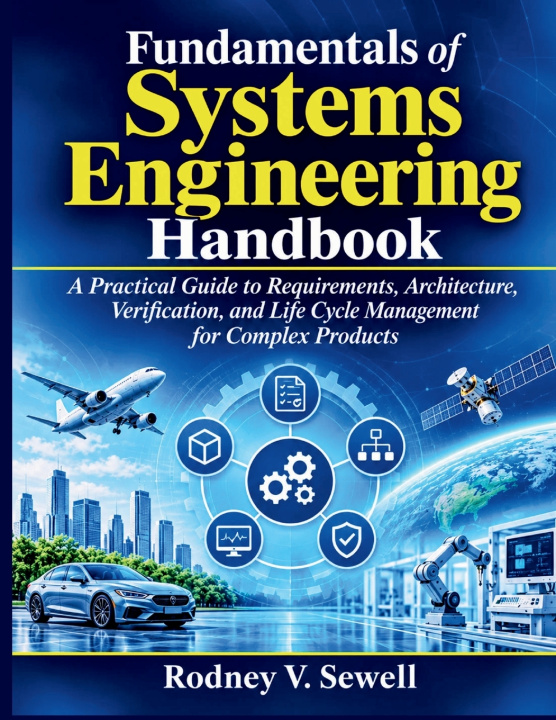
Fundamentals of Systems Engineering Handbook
A Practical Guide to Requirements, Architecture, Verification, and Life Cycle Management for Complex Products
 Angličtina
 258 b
 Nové
Až 30 dní na vrátenie tovaru

See the Whole System Before It Surprises You
You have probably seen it. Every subsystem reports green, every team hits its milestone, and the program still slips. Integration uncovers an interface two teams each thought the other had defined. A test proves the design meets its specification, and then the customer explains that the specification was never what they needed. Nobody did bad work. The failure lived in the gaps between good work, and by the time it surfaced, fixing it cost many times what catching it early would have.
The engineers who prevent those moments are not smarter than everyone else. They have learned to look at the whole system: to ask who needs what, to trace each requirement to a test, and to treat every interface and margin as something someone must own. That way of thinking is systems engineering, and it can be learned.
This handbook teaches it in the order you meet it on a real program, from the first stakeholder conversation to the day the product is retired. You will work through life cycle models and decision gates; stakeholder needs and requirements you can verify and trace; architecture, interfaces, and trade studies; model-based systems engineering; risk, margins, and configuration control; reliability, safety, and security; and integration, verification, validation, operations, and technical leadership.
What makes it stay with you is that you watch the methods work. Five fictional case programs run through the book: an air ambulance drone service, a water treatment upgrade, a mobile imaging cart, a small Earth observation satellite, and a warehouse robot fleet. Design Walkthroughs show each calculation step by step, from interface counts and error budgets to fault trees, availability, and test sample sizes. Failure Lessons trace how real and illustrative failures unfolded and what would have caught them. Standards Commentary panels show where each practice sits in the international standards your organization may already use.
You may be wondering whether this book is for you.
Students get a working context for course material.
Engineers moving into systems roles see what the job involves day to day.
Technical leads get review checklists and questions that expose weak plans.
The math stays at algebra, basic probability, and exponential functions. No modeling tool is assumed. There are no end-of-chapter drills; that space goes to longer worked reasoning, which instructors can adapt into assignments.
You also get reference material you will return to: a crosswalk to the ISO/IEC/IEEE 15288:2023 processes and NASA's common technical processes, work product outlines, review checklists, reference tables for test planning and reliability, an acronym list, a glossary of 139 terms, and a full index.
The decisions that set a system's cost and success are made early, often in a program's first months. The habits that catch problems are easiest to build before your next requirements review, not after your next integration surprise.
If you want to be the engineer who sees the gap before it becomes the failure, this handbook is the place to start.


Informácie o knihe
Angličtina

Darujte túto knihu ešte dnes
Je to jednoduché
1 Pridajte knihu do košíka a vyberte možnosť doručiť ako darček 2 Obratom Vám zašleme poukaz 3 Knihu zašleme na adresu obdarovanéhoAhoj! Som Libroamiko, tvoj knižný radca.
Ako ti môžem pomôcť?