
 Kontakt
 Ako nakupovať
Doručenie
Nákupný poradca
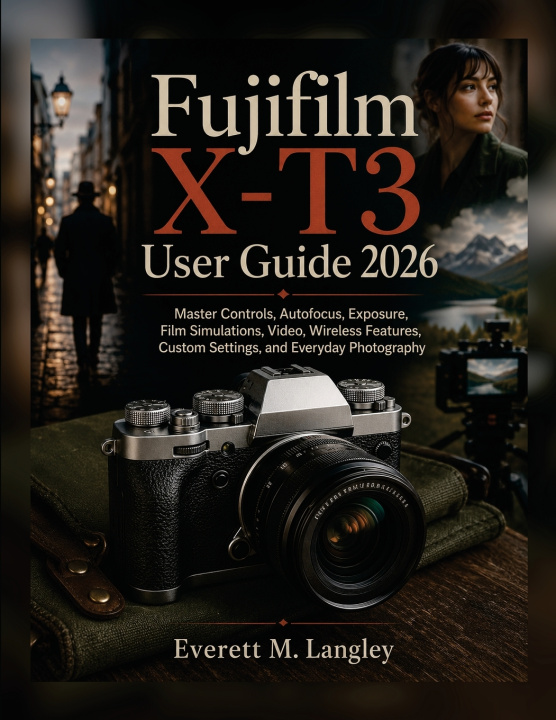
Fujifilm X-T3 User Guide 2026
Master Controls, Autofocus, Exposure, Film Simulations, Video, Wireless Features, Custom Settings, and Everyday Photography
 Angličtina
 44 b
44 b
 Nové
Nové
Až 30 dní na vrátenie tovaru

The Fujifilm X-T3 looks wonderfully direct from the outside.
Shutter speed has a dial. ISO has a dial. Exposure compensation has a dial. Aperture may be right under your fingers.
Then you start photographing.
A subject begins moving. Focus goes somewhere you did not expect. The light shifts. A JPEG needs a different character. Video requires another set of decisions. The wireless connection refuses to behave exactly as remembered. Suddenly, knowing where a control is located is not enough.
Fujifilm X-T3 User Guide 2026 is about knowing what to change-and why.
Rather than treating the camera as a collection of menu items, this practical guide connects its controls to the situations photographers actually encounter.
Seven decisions become much easier:When the subject moves: choose focusing behavior and AF-area options that make sense for the movement instead of relying on one autofocus setup for everything.
When the light changes: bring shutter speed, aperture, ISO, metering, and exposure compensation together so that brightness, motion, and depth are intentional choices.
When color matters: understand how film simulations, white balance, image settings, and JPEG choices can shape the character of a photograph before editing begins.
When speed matters: organize controls, shortcuts, function assignments, and custom settings so the camera responds quickly without repeated menu hunting.
When still photographs become motion: approach frame rate, resolution, focusing, exposure, stabilization choices, and recording settings with a clearer video workflow.
When the camera needs to communicate: work more confidently with smartphone connections, image transfer, wireless functions, and supported remote or tethered operation.
When the photograph matters more than the menu: apply the camera to portraits, action, landscapes, low light, everyday scenes, and other real situations with a clearer idea of what deserves adjustment first.
The result is not a camera filled with somebody else's recommended settings.
It is an X-T3 configured around the way you photograph.
That distinction matters. A useful setting for a moving subject may be unnecessary for a quiet portrait. A film simulation that suits one atmosphere may weaken another. A high shutter speed may freeze the moment beautifully-or remove the movement that made the scene interesting in the first place.
Understanding those trade-offs is what turns camera operation into photography.
Don't leave the next photograph to whichever setting happened to be left on the camera. Make the X-T3 respond to the picture you intend to create-and know exactly what to reach for when the scene changes.
FUJIFILM, X-T3, and related product and software names are trademarks or property of their respective owners. This independent educational publication is not affiliated with, authorized by, sponsored by, or endorsed by FUJIFILM Corporation or its affiliates. Product names are used solely for identification and educational reference. Features and connectivity options may vary with firmware, software, accessories, and compatible devices; consult the official documentation for current specifications.


Informácie o knihe
Angličtina

Darujte túto knihu ešte dnes
Je to jednoduché
1 Pridajte knihu do košíka a vyberte možnosť doručiť ako darček 2 Obratom Vám zašleme poukaz 3 Knihu zašleme na adresu obdarovanéhoAhoj! Som Libroamiko, tvoj knižný radca.
Ako ti môžem pomôcť?