
 Kontakt
 Ako nakupovať

Doručenie
Nákupný poradca
 Angličtina
 58 b
 Nové
Až 30 dní na vrátenie tovaru

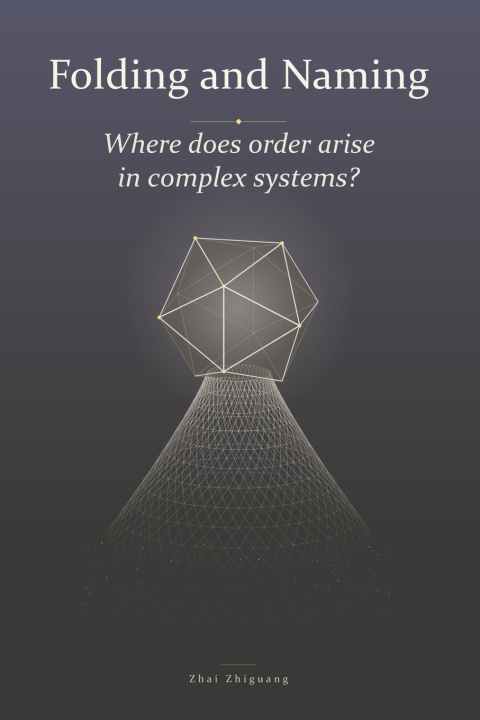
Every complex system that survives does the same two things: it folds detail into a
representative, and then it gives that representative a name.
Folding is compression that keeps the door open - the detail is represented, not deleted,
and can be unfolded when someone needs it. Naming is what turns an equivalence class into
an entity that can be referenced, tested, and reasoned about. Once you can see these two
moves, you start seeing them everywhere: in the TCP/IP stack, in a compiler's intermediate
representation, in a management hierarchy, in a cell's developmental program, and in the
context window of a language-model agent.
This book builds one vocabulary for that pattern and then uses it to make decisions.
Part I sets the terms - layers, entropy reduction, interfaces, and the three elements every
interface must carry: an upward state view, a downward instruction set, and an invariant.
Most broken interfaces are missing exactly one of the three, and each failure has a
recognisable symptom.
Part II turns management into a finite state machine, uses abstract interpretation to
explain why abstractions leak, and verifies a real protocol stack. Part III covers what to
do when emergence runs past its leash, including a termination criterion - the
bounded-construction axiom - that decides whether a program halts by construction rather
than by testing.
Part IV walks the same grammar through networks, organisations, agents, and living
systems, then gives a six-step audit you can run on your own stack.
Part V is for working engineers and managers: twelve common misreadings, seven foldings
worth knowing, nine templates you can use today, and three end-to-end cases.
Who it is for: everyone who solves complex-system problems, whatever the job title.
The three who come in most often are managers trying to straighten out an
organisation, engineers trying to make an architecture movable, and AI-agent
engineers trying to keep an agent stable - but they are examples, not a gate. They
look unrelated, and still face the same enemy: complexity that was never folded.
If you are none of the three, the book says so out loud. The preface has a section
titled "If your field is none of these", and chapter 40 closes with a section of the
same name and five opening moves, mapped onto medicine, public policy, supply chains
and education. Each of the first 34 chapters also ends with a fifth bullet naming a
real school or industry that performs the same move under another name. The test is
structural, not professional: two or more layers, layers you can name, and a way to
tell when it has gone wrong.
No code to run, no maths beyond what a working engineer already has. Every claim
that can be checked is checked, and the ones that cannot are marked as illustrative.


Informácie o knihe
Angličtina

Darujte túto knihu ešte dnes
Je to jednoduché
1 Pridajte knihu do košíka a vyberte možnosť doručiť ako darček 2 Obratom Vám zašleme poukaz 3 Knihu zašleme na adresu obdarovanéhoAhoj! Som Libroamiko, tvoj knižný radca.
Ako ti môžem pomôcť?