
 Kontakt
 Ako nakupovať
Doručenie
Nákupný poradca
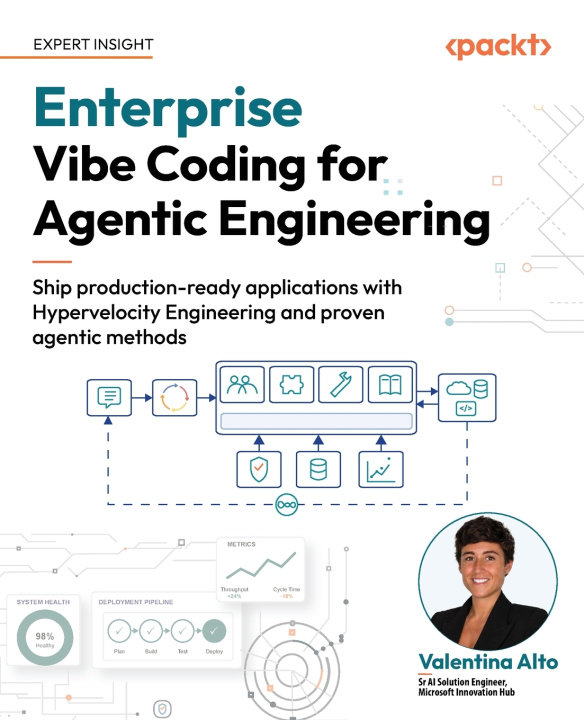
Enterprise Vibe Coding for Agentic Engineering
Ship production-ready applications with Hypervelocity Engineering and proven agentic methods
 Angličtina
 111 b
111 b
 Pripravujeme
 Nové
Nové
Až 30 dní na vrátenie tovaru

Move from vibe coding to governed enterprise agentic development with HVE and Loop Engineering. Apply RPI, MCP, agentic DevOps, policy-as-code, and reusable AI engineering patterns to ship software faster and safer.
Key Features:
- Turn vibe coding into governed enterprise delivery with HVE and Loop Engineering
- Build reusable agentic primitives with skills, agents, hooks, and MCP
- Ship faster with RPI, policy-as-code, and DevOps guardrails
- Access companion resources, reusable code samples, templates, and agentic primitives through the book's GitHub repository and Packt Resources
Book Description:
AI coding tools make first drafts cheap, but enterprise software still demands ownership, security, reviewability, and control. The challenge is no longer generating more code; it is engineering the loops, constraints, and evidence that make agentic delivery dependable.
This Playbook introduces Hypervelocity Engineering (HVE), a practical operating model for moving from ad hoc AI-assisted coding to steered, repeatable software delivery. You'll learn how repo-native instructions, skills, prompts, agents, hooks, and Model Context Protocol (MCP) turn one-off interactions into reusable engineering primitives.
The book then applies the Research → Plan → Implement (RPI) loop to requirements, design, coding, testing, security, and release. You'll see how agentic DevOps, policy-as-code, approval gates, bounded autonomy, and audit trails keep humans accountable while agents execute within clear constraints.
Three end-to-end enterprise blueprints-claims processing, conversational commerce, and campaign generations show how HVE works in practice. Reusable templates, checklists, and starter patterns help you apply the approach to your own repositories and teams, with GitHub Copilot used for demonstrations and principles that transfer to other leading AI coding assistants.
What You Will Learn:
- Move from vibe coding to governed agentic software delivery
- Apply HVE and Loop Engineering to enterprise development
- Build repo-native instructions, skills, agents, hooks, and MCP
- Use RPI loops to structure research, planning, and implementation
- Turn DevOps pipelines into active quality and security guardrails
- Define bounded autonomy, approvals, and escalation paths
- Encode engineering standards and governance as policy-as-code
- Apply reusable agentic patterns to real enterprise use cases
Who this book is for:
This book is for software developers, senior engineers, tech leads, platforms and DevOps teams, architects, and governance or security professionals adopting AI-assisted and agentic development. It is ideal for organizations that want the speed of vibe coding without sacrificing code ownership, testability, security, or auditability. Familiarity with repositories, CI/CD, software delivery, or AI coding assistants is helpful; the operating model itself is vendor-neutral.
Table of Contents
- The Impact of AI: From Vibe Coding to "Steered" Agentic Development
- Agentic AI and the New Way We Work
- Primitives: The Building Blocks of Agentic Development
- Reshaping the SDLC: Agentic DevOps and the RPI Cadence in Practice
- Governance: From Stochastic to Deterministic Agentic Development
- Use Cases: Building Agentic Solutions with the HVE Primitives
- Loop Engineering: Turning Primitives, RPI, and Governance into a Self-Running Delivery Loop
- From Steered Delivery to Agent Experience


Informácie o knihe
Angličtina
