Doprava zdarma pre objednávky nad 59,99 € s Packetou a SPS Boxmi.

Staňte sa súčasťou komunity milovníkov kníh z celého sveta a získajte hromadu výhod.
Založiť účet zdarma
Doprava zadarmo s Packetou nad 59.99 €
Kuriér DPD 2.99 €
Zberné miesto GLS 2.99 €
SPS 3.99 €
Kuriér GLS 3.49 €
SPS Parcel Shop 2.99 €
Packeta kurýr 3.99 €
Pošta 3.99 €
Zberné miesto DPD 2.99 €
Zberné miesto DPD 0.00 €
Packeta 2.99 €
 Kontakt
 Ako nakupovať
Pomoc
Doručenie
Kuriér DPD 2.99 €
Zberné miesto GLS 2.99 €
SPS 3.99 €
Kuriér GLS 3.49 €
SPS Parcel Shop 2.99 €
Packeta kurýr 3.99 €
Pošta 3.99 €
Zberné miesto DPD 2.99 €
Zberné miesto DPD 0.00 €
Packeta 2.99 €
Doprava zadarmo s Packetou nad 59.99 €
Nákupný poradca
Sme tu pre Vás!
02/210 210 99
Môj účet
▸
Prázdny :-(
0
Doprava zdarma pre objednávky nad 59,99 € s Packetou a SPS Boxmi.
Jazyk
 Angličtina
Angličtina
Kniha
Brožovaná
80% of your maintenance costs are determined during designFour hours of downtime equals $4,200 in da...
Celý popis
Libristo kód: 52477168
?
 84 b
84 b
 Nové
Nové
84 b
Nové
34.75
€
Očakávané naskladnenie
Naskladnenie 22. 05. 2026
30 dní na vrátenie tovaru

80% of your maintenance costs are determined during design
Four hours of downtime equals $4,200 in damage. The real cost? $18,000 over three years - because during design a cheaper motor was chosen that saved $3,000. Every $1,000 saved in design causes on average $47,000 in extra maintenance costs over the asset's lifetime.
The problem: 80% of reliability problems originate during design and construction. This book shows you how to build reliability in from the very first design decision. Every phase treated systematically with concrete methodologies and calculation models.
Complete methodology in 6 phases
- Phase 1: Understanding the problem - the 80/20 rule of reliability engineering, the 5-Why technique for root causes, the iceberg principle: real costs are 3-5 times higher than visible repair costs
- Phase 2: Specifications - stakeholder analysis, Early Equipment Management, and RAMS methodology (Reliability, Availability, Maintainability, Safety) to define quantitative objectives
- Phase 3: Criticality analysis - set priorities across five risk dimensions: safety, environment, delivery reliability, quality, and sustainability. Determine which assets deserve $50,000-$500,000 in engineering versus a $500 basic analysis. Result: $1.3 million in savings, 18% higher availability
- Phase 4: Design - FMEA: seven core questions identify all failure modes, RPN prioritizes improvements. Maintainability: five design principles (accessibility, visibility, standardization, modularity, diagnostics). RCM prevents both over- and under-maintenance
- Phase 5: Economic justification - Life Cycle Costing: pump B ($12,000) saves $85,000 versus pump A ($8,000) through lower energy and maintenance costs. NPV calculations and business cases that convince management
- Phase 6: Realization - commissioning, systematic supplier selection, and portfolio management creating $1.4 million in additional value
- 35% lower lifecycle costs through thorough analysis
- Up to 47:1 return on reliability investment
- $1.3 million savings through criticality analysis
- $50,000-$100,000 gain per asset through LCC
- 60-80% fewer commissioning problems
FMEA worksheets, LCC calculators, criticality matrix, business case templates, supplier scorecard, and commissioning checklists.
Who is this book for?
Project managers, maintenance managers, asset managers, reliability engineers, technical directors, procurement professionals, and consultants responsible for new assets. Applicable across manufacturing, process industry, energy, utilities, transport, healthcare, and public sector organizations.
Part of a larger whole
This is the eighth volume of The Reliability Framework, a nine-book series covering technical asset management. Each book covers one subject systematically and in depth.
About the author
Martin Van den Hout has 35 years of experience in maintenance and reliability, including 24 years as a consultant. He has guided hundreds of projects across manufacturing, chemical, and process industries. He wrote a leading university-level textbook on maintenance management and delivers in-company training programs in FMEA, RCM, and LCC.
Stop paying to fix in operations what went wrong during design.
Herečka
&
Polyglotka
EWA KASP
pre
Prehrať video


Libristo má najväčší výber cudzojazyčnej literatúry. Preto si knihy kupujem tu.
Informácie o knihe
Celý názov
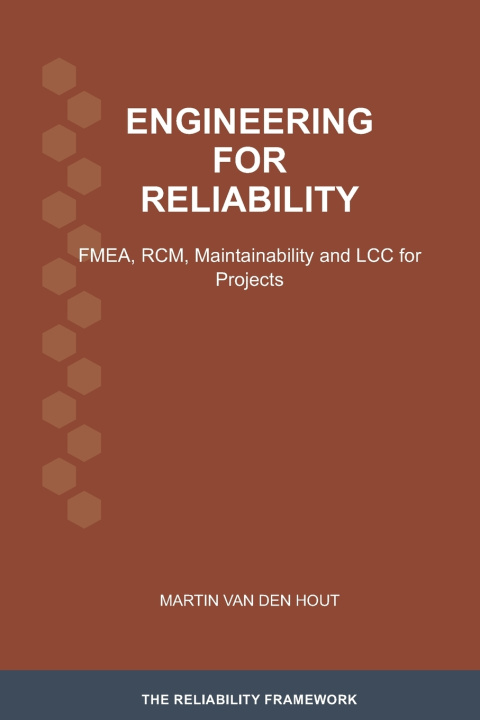
Engineering for Reliability
Autor
Martin Van den Hout
Jazyk
Angličtina
Angličtina
Väzba
Kniha - Brožovaná
Dátum vydania
2026
Počet strán
176
EAN
9789083643199
ISBN
9083643190
Libristo kód
52477168
Nakladateľstvo
Vulcanus Press
Váha
245
Rozmery
152 x 229 x 10
