
 Kontakt
 Ako nakupovať
Doručenie
Nákupný poradca
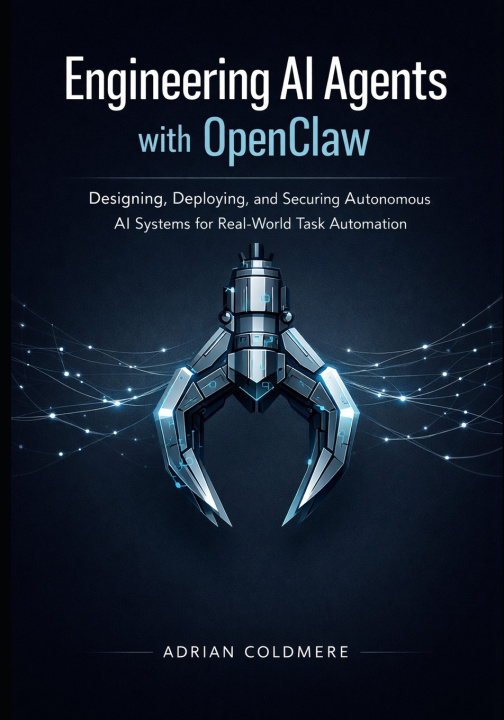
Engineering AI Agents with OpenClaw
Designing, Deploying, and Securing Autonomous AI Systems for Real-World Task Automation
 Angličtina
 60 b
60 b
Až 30 dní na vrátenie tovaru

Artificial intelligence is entering a new era.
For years, AI systems have been tools responding to prompts, answering questions, and generating text when asked. But a quiet revolution is underway. Across engineering teams, startups, and research labs, a new class of software is emerging: autonomous AI agents that can reason, plan, act, and complete real-world tasks with minimal supervision.
These systems don't just respond.
They work.
They monitor systems overnight, diagnose problems before engineers wake up, triage emails, analyze data, coordinate workflows, and interact with APIs, filesystems, and software platforms just like a digital teammate.
Engineering AI Agents with OpenClaw is a practical, deeply technical guide to building and deploying these autonomous systems in the real world.
Rather than focusing on hype or theory, this book shows you how modern agent systems actually work under the hood and how to design them so they are powerful, reliable, secure, and production-ready.
You will explore the architecture behind autonomous AI systems, learn how agents reason and plan tasks, connect them to tools and APIs, give them memory and context, and deploy them safely in real environments.
By the end of this book, you will understand how to design AI agents that can monitor infrastructure, automate workflows, coordinate across systems, and operate continuously as intelligent collaborators.
This is not a book about chatbots.
It is about the next generation of software systems.
What You'll Learn
• How autonomous AI agents actually work internally
• Designing the perception, reasoning and action loop used by modern agents
• Building agent workflows that perform complex multi-step automation
• Integrating AI agents with APIs, databases, command-line tools, and external systems
• Implementing memory systems using embeddings and vector databases
• Coordinating multi-agent systems for complex workflows
• Monitoring and debugging autonomous agents in production
• Securing agents against prompt injection, tool exploits, and permission abuse
• Deploying scalable AI agent infrastructure in cloud and enterprise environments
The future of software is not just applications.
It is autonomous systems that can reason, act, and collaborate with humans.
The teams that understand how to build them will shape the next generation of technology.
The question is simple:
Will you be one of them?


Informácie o knihe
Angličtina
