
 Kontakt
 Ako nakupovať

Doručenie
Nákupný poradca
 Angličtina
 39 b
 Nové
Až 30 dní na vrátenie tovaru

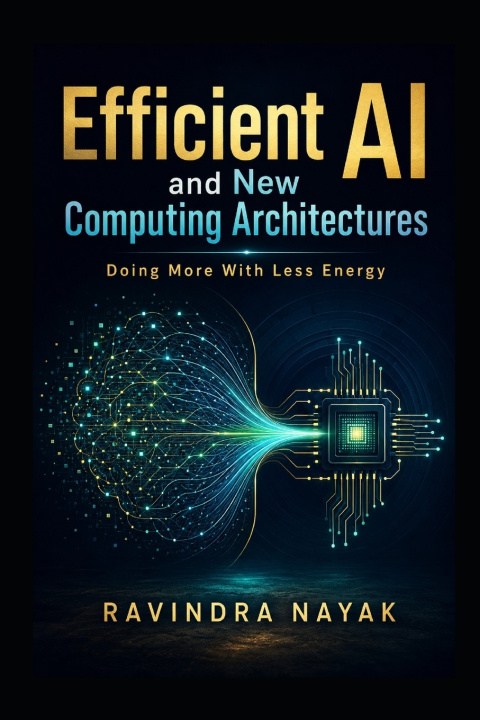
AI can feel weightless. Ask a question, tap a button, receive an answer. But behind that simple moment, information is moved, stored, transformed, routed, cooled, and delivered by physical systems that consume energy, memory, bandwidth, time, and money.
Efficient AI and New Computing Architectures: Doing More With Less Energy makes that hidden world understandable without requiring an engineering background. Starting from first principles, the book asks a practical question: how much intelligence does a task really need, and what is the smartest way to provide it without wasting constrained resources?
Through plain-language explanations, dialogues, visual learning, gentle mathematics, and hands-on thinking exercises, you will learn why bigger is not automatically better. You will follow data through memory and processors, see how latency differs from throughput, identify bottlenecks, and understand why moving data can matter as much as performing arithmetic. You will explore quantization, sparsity, distillation, conditional computation, model routing, caching, batching, specialized accelerators, edge and cloud placement, neuromorphic ideas, near-memory approaches, chiplets, photonic computing, thermal limits, reliability, lifecycle cost, and whole-system efficiency.
The book also teaches something more durable than hardware vocabulary: how to evaluate new technology without fear or hype. You will learn to define useful work, choose a system boundary, compare alternatives with simple ratios and expected-value thinking, grade evidence, challenge benchmarks, preserve reversibility, and make technical decisions that can be explained and revisited.
If computer architecture has always seemed too technical, or if AI efficiency sounds like a subject reserved for specialists, this book is designed to change that. The goal is not to make you memorize machines. It is to help you see the structure beneath them-goal, information, work, resource, constraint, choice, measurement, and feedback-so unfamiliar technologies become easier to reason about.
For curious readers, technology professionals, students, managers, builders, and decision-makers who want a calm, practical understanding of efficient AI systems, this is a first-principles path from hidden cost to better judgment.


Informácie o knihe
Angličtina

Darujte túto knihu ešte dnes
Je to jednoduché
1 Pridajte knihu do košíka a vyberte možnosť doručiť ako darček 2 Obratom Vám zašleme poukaz 3 Knihu zašleme na adresu obdarovanéhoAhoj! Som Libroamiko, tvoj knižný radca.
Ako ti môžem pomôcť?