
 Kontakt
 Ako nakupovať
Doručenie
Nákupný poradca
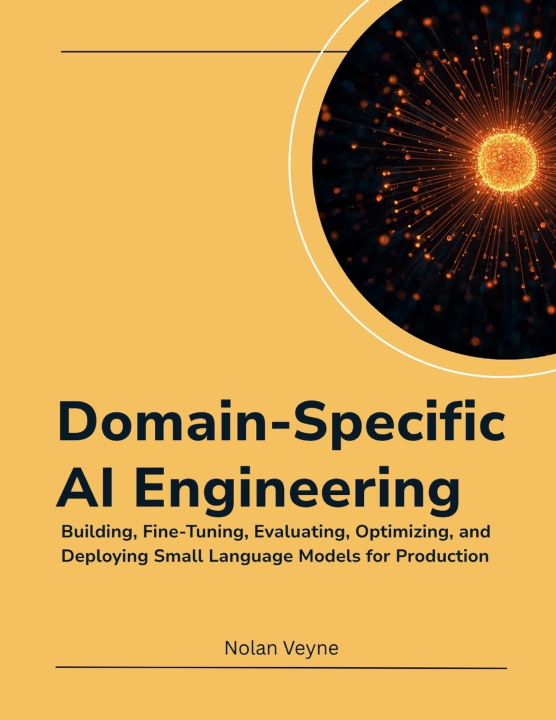
Domain-Specific AI Engineering
Building, Fine-Tuning, Evaluating, Optimizing, and Deploying Small Language Models for Production
 Angličtina
 44 b
44 b
 Pripravujeme
 Nové
Nové
Až 30 dní na vrátenie tovaru

The future of production AI isn't one enormous model doing everything. It's the right models, data, retrieval, evaluation, and infrastructure working together for the right tasks.
Building a demo with a general-purpose LLM is easier than ever. Building a domain specific AI system that delivers accuracy, predictable latency, controlled cost, privacy, deployment flexibility, and long-term reliability is a very different challenge.
If you're an AI engineer, machine learning practitioner, software engineer, architect, or developer moving beyond basic LLM experimentation, you need more than prompts and isolated training recipes. You need a production AI engineering methodology for deciding when small language models are sufficient, when larger models are necessary, what belongs in retrieval, what belongs in model weights, and how to prove that your system is ready for production.
Domain-Specific AI Engineering gives you that complete framework:
Define → Select → Curate → Adapt → Evaluate → Optimize → Deploy → Observe → Improve
Rather than treating LLM fine tuning, RAG, evaluation, optimization, and deployment as disconnected techniques, Nolan Veyne shows you how to combine them into an evidence-driven engineering lifecycle.
Inside, you'll learn how to:
Select and baseline small language models based on domain capability, latency, memory, hardware, privacy, and cost
Build governed, traceable domain datasets for training, validation, benchmarking, and evaluation
Apply domain adaptive pretraining, SFT, LoRA QLoRA, and preference optimization where they genuinely add value
Make informed RAG fine tuning decisions and combine retrieval with specialized models without confusing dynamic knowledge with learned behavior
Build rigorous LLM evaluation workflows using golden sets, challenge tests, hallucination and faithfulness analysis, human assessment, and regression gates
Apply quantization, distillation, batching, caching, and context management for practical LLM model optimization
Engineer reliable language model deployment across local, cloud, and edge environments
Design production APIs, model routing, verification, security, graceful degradation, and selective LLM fallback
Detect data drift, domain drift, retrieval failures, quality degradation, and rising production costs
Build controlled feedback loops, release gates, monitoring systems, and reusable engineering decision frameworks
Scale from one specialized model to a governed portfolio of production-ready AI capabilities
The question is no longer:
"Which model is the most powerful?"
It is:
"What is the smallest and simplest AI system that can reliably satisfy the required quality and operational constraints?"
Whether you're building an enterprise assistant, technical-support system, financial extraction model, engineering copilot, cybersecurity classifier, private knowledge interface, or another specialized AI application, this book gives you a practical path from model selection to production operation.
Don't just fine-tune a model. Engineer the complete system around it.
Get Domain-Specific AI Engineering by Nolan Veyne and learn how to build specialized language models that are measurable, efficient, optimized, deployable, and ready for real production workloads.


Informácie o knihe
Angličtina

Darujte túto knihu ešte dnes
Je to jednoduché
1 Pridajte knihu do košíka a vyberte možnosť doručiť ako darček 2 Obratom Vám zašleme poukaz 3 Knihu zašleme na adresu obdarovanéhoAhoj! Som Libroamiko, tvoj knižný radca.
Ako ti môžem pomôcť?