
 Kontakt
 Ako nakupovať
Doručenie
Nákupný poradca
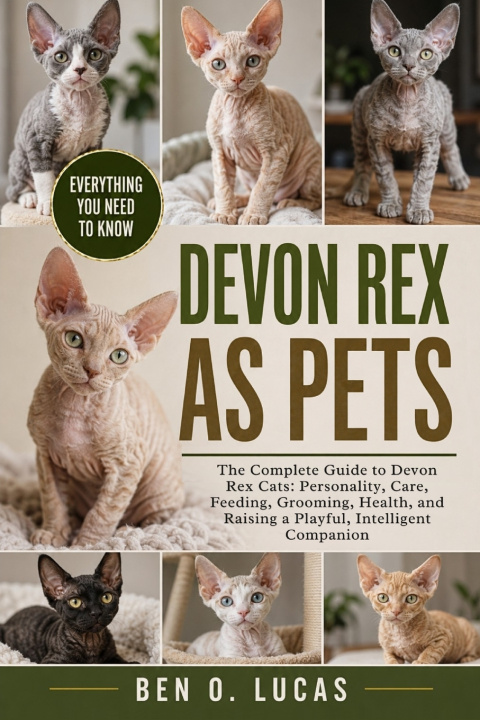
DEVON REX AS PETS
The Complete Guide to Devon Rex Cats: Personality, Care, Feeding, Grooming, Health, and Raising a Playful, Intelligent Companion
 Angličtina
 37 b
37 b
 Nové
Nové
30 dní na vrátenie tovaru

INTRODUCTION
Introduction to the Devon Rex
Origins of an Unusual Cat
The story of the Devon Rex begins not in a laboratory or through deliberate breeding, but in the quiet countryside of Devonshire, England, during the late 1950s. This was a time when cat breeding was far less commercialized than it is today, and many remarkable discoveries happened purely by chance. The Devon Rex owes its existence to one such moment, when a woman named Beryl Cox noticed a peculiar kitten among a litter near an abandoned tin mine in Buckfastleigh. This kitten stood out immediately, not because of size or color, but because of its soft, curly coat and unusually large ears.
At first glance, the kitten appeared almost otherworldly. Unlike the straight-haired cats common at the time, its coat formed delicate waves that felt more like suede than fur. This distinctive texture was the result of a natural genetic mutation, something that occurs occasionally in animals but rarely becomes the foundation of an entirely new breed. Intrigued, Beryl Cox adopted the kitten and named him Kirlee, a name that would later become deeply significant in feline history.
Initially, there was some confusion regarding the kitten's identity. Around the same period, another curly-coated breed, the Cornish Rex, had already been discovered in Cornwall, England. Many believed Kirlee might be related to that breed. However, when breeding attempts were made between Kirlee and Cornish Rex cats, the resulting kittens had straight coats, not curly ones. This unexpected outcome revealed something fascinating: the genetic mutation responsible for the Devon Rex's coat was entirely different. It was not simply a variation of the Cornish Rex but an entirely separate genetic line.
This discovery marked the true beginning of the Devon Rex as a distinct breed. From that single kitten, breeders began carefully developing a stable line that would preserve the unique traits while ensuring good health and temperament. Over time, the Devon Rex gained recognition and admiration, not only in the United Kingdom but across the world.
The Evolution of the Breed
As breeding programs progressed, the Devon Rex began to take on a more defined and recognizable form. Unlike many breeds that were shaped primarily for appearance, the development of the Devon Rex balanced both aesthetics and personality. Breeders were fascinated by the cat's delicate frame, long legs, and slender body, which gave it an elegant yet playful silhouette. At the same time, its oversized ears and wide-set eyes contributed to an expressive, almost mischievous facial appearance.
The coat remained the most defining feature. Soft, wavy, and often described as "rexed," it lacks the typical guard hairs found in most cats. This gives the Devon Rex its signature velvety feel, making it stand apart from even other curly-coated breeds. However, the coat can vary from cat to cat. Some individuals have tighter curls, while others may have looser waves or even patches where the coat is thinner. This variability is part of what makes each Devon Rex unique.
Recognition by major cat registries soon followed. Organizations such as The International Cat Association and Cat Fanciers' Association officially acknowledged the Devon Rex as a distinct breed, which helped establish breeding standards and promote responsible practices. These standards ensured that the breed's defining traits, including its coat, structure, and personality, would be preserved for future generations.
As the breed spread internationally


Informácie o knihe
Angličtina
