
 Kontakt
 Ako nakupovať
Doručenie
Nákupný poradca
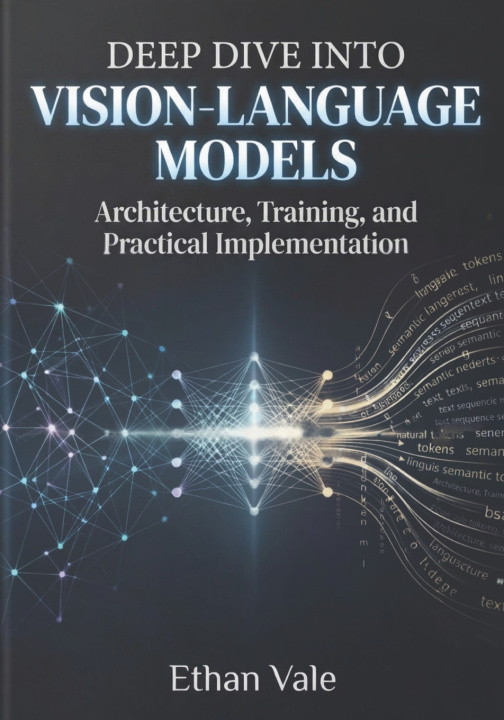
Deep Dive into Vision-Language Models
Architecture, Training, and Practical Implementation
 Angličtina
 45 b
45 b
 Pripravujeme
 Nové
Nové
Až 30 dní na vrátenie tovaru

Unlock the Core Mechanics and Practical Engineering Behind Multimodal AI
The boundary between computer vision and natural language processing has dissolved. Modern artificial intelligence is no longer restricted to isolated modalities that only classify images or generate plain text. Today, developers and machine learning engineers need to build systems that can see, reason, and converse simultaneously.
Deep Dive into Vision-Language Models is an authoritative, end-to-end technical guide designed to take you beyond surface-level API calls and into the foundational architecture, training methodologies, and practical implementation of modern multimodal foundation models.
What You Will Master:
The Modality Alignment Challenge: Understand the mathematical and structural obstacles of bridging continuous visual patches with discrete linguistic tokens.
Core VLM Anatomy: Deconstruct Vision Transformers (ViT), decoder-only language backbones, and multimodal fusion layers including linear projectors, MLPs, cross-attention mechanisms, and Q-Formers.
Pre-Training and Alignment Strategies: Explore contrastive learning (CLIP, SigLIP), masked autoencoding (FLAVA), and generative pre-training pipelines.
Visual Instruction Tuning: Learn the complete two-stage training recipes behind influential architectures like LLaVA, from synthetic dataset generation to parameter freezing schedules.
Consumer-Grade Efficiency: Implement Parameter-Efficient Fine-Tuning (PEFT) using LoRA, QLoRA 4-bit quantization, and Direct Preference Optimization (DPO) to prevent visual hallucination.
Hands-On Production Code: Build custom data collators, format conversational JSONL datasets, and execute supervised fine-tuning (SFT) using PyTorch, Hugging Face Transformers, and the TRL library.
Benchmarking and Advanced Frontiers: Evaluate systems with LMMS-Eval and MMBench, then expand beyond static images into Video VLMs, document understanding (OCR), 3D spatial reasoning, and visual agentic workflows.
Who This Book Is For:
Whether you are a deep learning practitioner, software engineer, NLP specialist expanding into computer vision, or an AI researcher, this book equips you with the reusable architectural patterns and production-ready code needed to build, fine-tune, and deploy custom vision-language models with confidence.
Step into the future of multimodal AI. Get your copy today.


Informácie o knihe
Angličtina
