
 Kontakt
 Ako nakupovať
Doručenie
Nákupný poradca
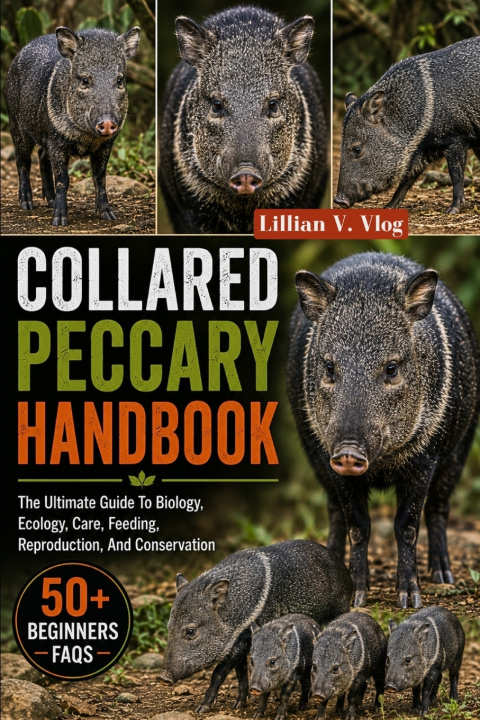
COLLARED PECCARY HANDBOOK
The Ultimate Guide To Biology, Ecology, Care, Feeding, Reproduction, And Conservation
 Angličtina
 Nové
Nové

INTRODUCTION TO THE COLLARED PECCARY
The Collared peccary is a fascinating and often misunderstood mammal that occupies a unique place in the natural world. Known by several regional names such as javelina, musk hog, or simply peccary, this species is not a true pig, despite its superficial resemblance. Instead, it belongs to a distinct family of hoofed mammals that evolved separately and developed their own specialized adaptations for survival. Found across a wide geographic range stretching from the southern United States through Central America and into much of South America, the collared peccary is one of the most adaptable and resilient animals in the Western Hemisphere.
Understanding the collared peccary begins with recognizing its identity as a member of the Tayassuidae family, a small but distinctive group of hoofed mammals that diverged from true pigs millions of years ago. While they share certain characteristics with pigs-such as a stout body, short legs, and a flexible snout-the differences between them are significant. These differences extend beyond anatomy and into behavior, ecology, and social structure, making peccaries a subject of great interest to scientists, wildlife enthusiasts, and conservationists alike.
A Species Often Mistaken but Rarely Understood
At first glance, the collared peccary may look like a small wild pig. It has a bristly coat, a compact body, and a rounded snout used for rooting through soil. However, closer observation reveals several distinctive features. One of the most recognizable traits is the pale, collar-like band of fur that runs around its neck and shoulders, giving the species its common name. This collar contrasts with the darker body fur and serves as an easy visual identifier in the wild.
Beyond appearance, the collared peccary possesses anatomical traits that set it apart. Its tusks are smaller and straighter than those of pigs, and its digestive system is more complex, allowing it to process tough vegetation such as cacti and fibrous plants. Unlike pigs, which have a relatively simple stomach, peccaries have a more compartmentalized digestive system that functions somewhat similarly to that of ruminants, though not as specialized. This adaptation enables them to thrive in harsh environments where food resources are limited.
Another defining feature is the presence of a dorsal scent gland located on the animal's back. This gland produces a strong musky odor used for communication within the herd. Members of a group will rub against each other to share scent, reinforcing social bonds and group identity. This behavior highlights the importance of social cohesion in peccary life, a theme that runs throughout their biology and ecology.
Evolutionary Origins and History
The evolutionary history of the collared peccary is both ancient and complex. Fossil evidence suggests that the ancestors of modern peccaries appeared during the Miocene epoch, around 20 million years ago. During this time, early relatives of both pigs and peccaries spread across various continents. Over time, these groups diverged, with peccaries becoming isolated in the Americas.
Unlike true pigs, which are native to Europe, Asia, and Africa, peccaries evolved entirely in the New World. This geographic isolation led to the development of unique traits suited to the environments of North and South America. When the land bridge between North and South America formed during the Great American Biotic Interchange, peccaries expanded their range and diversified further.
Today, the collared peccary is one of three extant species of peccaries, alongside the white-lipped peccary and the Chacoan peccary. Among these, the collared peccary is the most widespread and adaptable, capable of living in a variety of habitats ranging from arid deserts to tropical rainforests.


Informácie o knihe
Angličtina

Darujte túto knihu ešte dnes
Je to jednoduché
1 Pridajte knihu do košíka a vyberte možnosť doručiť ako darček 2 Obratom Vám zašleme poukaz 3 Knihu zašleme na adresu obdarovanéhoAhoj! Som Libroamiko, tvoj knižný radca.
Ako ti môžem pomôcť?