
 Kontakt
 Ako nakupovať

Doručenie
Nákupný poradca
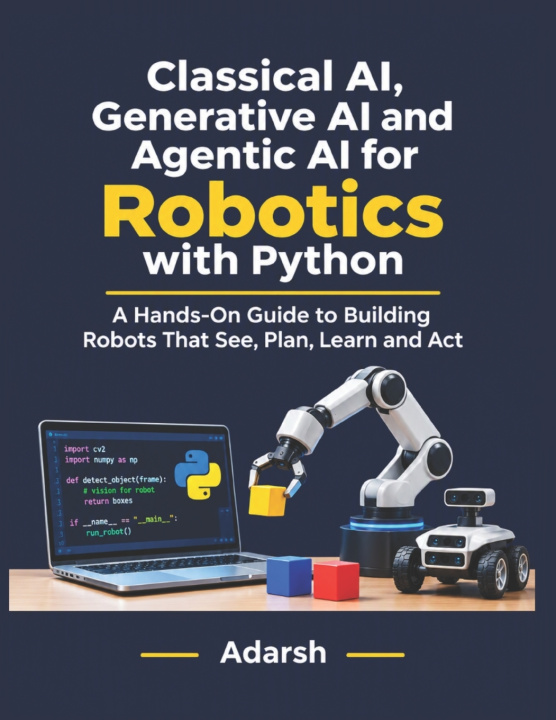
Classical AI, Generative AI and Agentic AI for Robotics with Python
A Hands-On Guide to Building Robots That See, Plan, Learn and Act
 Angličtina
 89 b
 Pripravujeme
 Nové
 Dodáme do Vianoc ▾
Očakávané naskladnenie
Naskladnenie 17. 11. 2026
Až 30 dní na vrátenie tovaru

Robots are leaving the factory cage. For half a century, industrial robots repeated precise motions in carefully controlled cells, and robot intelligence meant geometry, control theory and careful engineering. In just a few years, three waves of artificial intelligence have changed what robots can do. Classical AI gave them planning, localisation and control. Machine learning and deep learning gave them perception and learned skills. And now generative AI and agentic AI are giving them the ability to understand language, recognise objects nobody labelled, generate their own motions, reason over long tasks and work as autonomous agents.
This book teaches all three waves, and above all how they fit together, using Python, the language in which almost all robot intelligence is now written. It is written for software developers who want to work on robots, robotics engineers who want to use modern AI, students of robotics and AI, and practitioners who want to understand what large language models, vision-language-action models, diffusion policies and AI agents can and cannot do for a physical machine.
What Makes This Book Different
One robot, three waves. Rather than treating classical robotics and modern AI as separate subjects, the book builds a single stack layer by layer. Fast, verifiable control and safety sit at the bottom; learned perception and skills in the middle; generative and agentic reasoning at the top. Each new technique is placed where it belongs in that stack.
Every idea runs. Every chapter ends in a hands-on project, and almost every listing in the book was executed while the book was written. The outputs, tables and plots you see are the real results of those runs, including the failures. You will see a policy that copies its teacher perfectly yet fails most of its tasks, a vision-language model that knows "purple" and "box" but not "purple box", and a safety supervisor that passes every hand-written test and then crashes under fuzzing. These surprises are deliberate parts of the lessons: intelligent robots are built by people who measure honestly and expect failure.
Small enough to run anywhere. The projects are scaled to train in minutes on an ordinary laptop CPU, with no GPU and no cloud account required. Where a technique needs a large pretrained model, the book either builds a miniature version from scratch, so that you can see exactly how it works, or shows how to use the real model and says plainly which listings could not be run in the environment used to write the book.
Safety throughout. Agentic robots combine the unpredictability of generative models with the irreversibility of physical action. Safety is therefore not confined to one chapter: speed limiters, validation, supervisors and human approval appear wherever AI meets motors, culminating in Chapter 21.
Suggested Reading Paths
- Complete course: read the chapters in order. Each builds on the ones before, and the capstones of Chapter 23 draw on all of them.
- Software developers new to robotics: Chapters 1 to 6, then Chapters 12, 17, 18 and 21.
- Roboticists new to modern AI: skim Part I, then Chapters 7 to 16 and Part IV.
- Machine learning engineers new to robotics: Chapters 1, 3, 4 and 6, then Chapters 9, 10 and 14 to 16, and Chapter 22.
- Agentic AI focus: Chapters 1, 4 and 12, then Part IV and Chapter 23.


Informácie o knihe
Angličtina

Darujte túto knihu ešte dnes
Je to jednoduché
1 Pridajte knihu do košíka a vyberte možnosť doručiť ako darček 2 Obratom Vám zašleme poukaz 3 Knihu zašleme na adresu obdarovanéhoAhoj! Som Libroamiko, tvoj knižný radca.
Ako ti môžem pomôcť?