Doprava zdarma pre objednávky nad 59,99 € s Packetou a SPS Boxmi.

Staňte sa súčasťou komunity milovníkov kníh z celého sveta a získajte hromadu výhod.
Založiť účet zdarma
Doprava zadarmo s Packetou nad 59.99 €
Kuriér DPD 2.99 €
Kuriér GLS 3.99 €
Zberné miesto GLS 2.49 €
SPS 3.99 €
SPS Parcel Shop 2.99 €
Packeta kurýr 3.99 €
Slovenská pošta 3.99 €
Zberné miesto DPD 2.99 €
Packeta 2.99 €
 Kontakt
 Ako nakupovať

Pomoc
Doručenie
Kuriér DPD 2.99 €
Kuriér GLS 3.99 €
Zberné miesto GLS 2.49 €
SPS 3.99 €
SPS Parcel Shop 2.99 €
Packeta kurýr 3.99 €
Slovenská pošta 3.99 €
Zberné miesto DPD 2.99 €
Packeta 2.99 €
Doprava zadarmo s Packetou nad 59.99 €
Nákupný poradca
Sme tu pre Vás!
02/210 210 99
Môj účet
▸
Prázdny :-(
0
Doprava zdarma pre objednávky nad 59,99 € s Packetou a SPS Boxmi.
Jazyk
 Angličtina
Kniha
Brožovaná
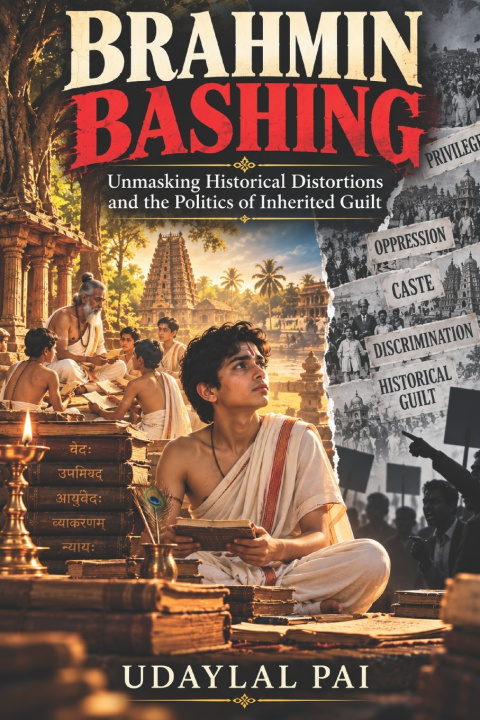
BRAHMIN BASHINGA Community on Trial. A History Worth Reconsidering.A SURNAME IS NOT A CRIME. A LINEA...
Celý popis
Libristo kód: 54316784
?
 67 b
 Nové
67 b
Nové
27.41
€
Skladom u dodávateľa
Odosielame za 9-13 dní
Až 30 dní na vrátenie tovaru

BRAHMIN BASHING
A Community on Trial. A History Worth Reconsidering.A SURNAME IS NOT A CRIME. A LINEAGE IS NOT A VERDICT.
Can a democratic society condemn a living human being for the alleged sins of his ancestors?
For generations, Brahmins have been portrayed as India's hereditary oppressors-wealthy, powerful, privileged, and collectively responsible for centuries of caste injustice. In political rhetoric, popular culture, and public debate, an entire community is too often reduced to a convenient villain.
But what happens when we examine the history behind the accusations?
Were Brahmins really the rulers of India for five thousand years? Who commanded the armies, controlled the kingdoms, and exercised the power of punishment? Were all Brahmins wealthy beneficiaries of an oppressive system-or did countless scholars, teachers, and priests spend their lives preserving knowledge while struggling to feed their own families?
And who remembers the Brahmins who themselves suffered persecution, violence, dispossession, and exile?
In Brahmin Bashing, author Udaylal Pai mounts a passionate, provocative, and historically grounded defence of a community too often judged by stereotype rather than evidence.
Moving from ancient scriptures and the preservation of Sanskrit to the persecution of Brahmin communities in Goa, Kashmir, Melukote, and Maharashtra, the book uncovers neglected histories and challenges deeply entrenched assumptions.
It explores the ethical ideals of Brahminhood, the traditions of learning and teaching, the distinction between religious authority and political power, and the poverty that often existed behind outward social respect. It also confronts contemporary caste politics, educational inequalities, and the struggles of ordinary Brahmin families whose circumstances rarely fit the popular image of inherited privilege.
Through historical inquiry, philosophical reflection, and deeply human stories, Brahmin Bashing asks readers to reconsider what they have been told-and what they may have accepted without question.
This is not a defence of caste discrimination. It is a defence against discrimination by caste.
The book does not claim that every Brahmin was virtuous, that historical injustice never existed, or that anyone deserves superiority by birth.
It demands something far more fundamental: that no human being should inherit personal guilt for wrongs he never committed.
If modern India can condemn colonial oppression without blaming every living descendant of the colonisers, why should a Brahmin child be expected to answer for centuries of history merely because of his surname?
If discrimination by birth is wrong, how can condemnation by birth be right?
Brahmin Bashing is more than a defence of a community. It is an appeal for historical truth, individual dignity, and justice without hereditary prejudice.
Before you condemn a community, examine its history. Before you accuse a person, discover who he is.
Herečka
&
Polyglotka
EWA KASP
pre
Prehrať video


Libristo má najväčší výber cudzojazyčnej literatúry. Preto si knihy kupujem tu.
Informácie o knihe
Celý názov
BRAHMIN BASHING
Autor
Udaylal Pai
Jazyk
Angličtina
Angličtina
Väzba
Kniha - Brožovaná
Dátum vydania
2026
Počet strán
790
EAN
9798165797941
Libristo kód
54316784
Nakladateľstvo
Independently published
Váha
1039
Rozmery
152 x 229 x 40

Darujte túto knihu ešte dnes
Je to jednoduché
1 Pridajte knihu do košíka a vyberte možnosť doručiť ako darček 2 Obratom Vám zašleme poukaz 3 Knihu zašleme na adresu obdarovaného
Knižný radca Libroamiko
Používaním tohto chatu komunikujete s generatívnou umelou inteligenciou. Jeho používaním tiež súhlasíte so spracovaním osobných údajov.
Ahoj! Som Libroamiko, tvoj knižný radca.
Ako ti môžem pomôcť?
Ahoj, som Libroamiko, môžem pomôcť?