
 Kontakt
 Ako nakupovať
Doručenie
Nákupný poradca
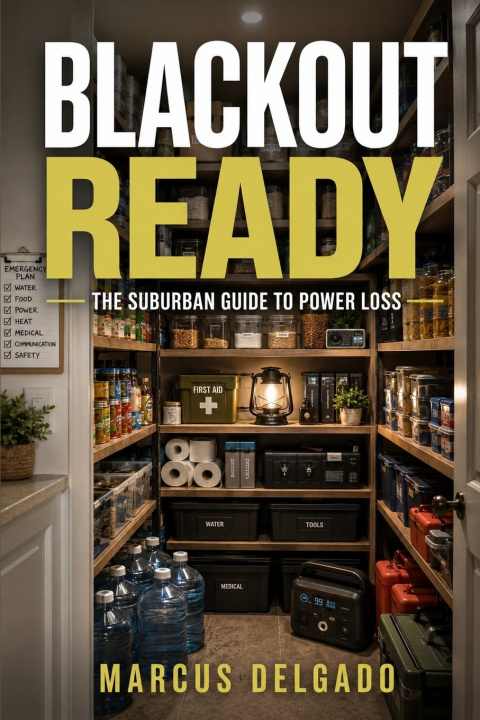
Blackout Ready
The Suburban Guide to Power Loss: Practical preparedness without paranoia for renters, homeowners, and families
 Angličtina
 24 b
24 b
 Nové
Nové
Až 30 dní na vrátenie tovaru

When the power fails, most suburban households aren't ready-and they have no idea where to start.
This book is for families who want real preparedness, not paranoia.
• Are you tired of feeling anxious about blackouts but overwhelmed by prepper culture that doesn't fit your life?
• Do you rent or own a condo and feel like all preparedness advice assumes you have a yard, a generator, and prior survival skills?
• Have you started gathering emergency supplies but have no idea if you're preparing for the right things-or if you'll actually use what you buy?
• Do you want your family safe during an outage without feeling like you're joining a subculture that makes you uncomfortable?
Most preparedness writing is written by and for rural homesteaders or extreme preppers. The advice assumes you have land, construction skills, political alignment with a particular ideology, and time to spend on gear optimization. If you're a suburban homeowner or urban renter with a nine-to-five job, a family to raise, and a reasonable budget, that advice either doesn't work for your situation or leaves you feeling excluded before you've even started. The gap between what the preparedness industry says you should do and what actually works for ordinary households living in cities and suburbs is massive-and it's actively making people less prepared, not more.
Marcus Delgado has spent two decades working in emergency response coordination, disaster logistics, and community preparedness in suburban and urban contexts across California and the Southwest. He grew up in a working-class household where preparedness wasn't ideology-it was dignity: the ability to take care of your own family without panic or desperation. He's sat in municipal emergency operations centers during grid failures, coordinated supply distribution in crisis conditions, trained community volunteers, and-critically-watched where mainstream preparedness advice fails in real-world situations. He's also spent years testing gear, food storage systems, and communication protocols in his own suburban household, documenting what actually works and what doesn't when you have no special skills and limited space.
This book reveals a fundamental truth that the mainstream preparedness industry won't tell you: suburban households are structurally more vulnerable than either rural or dense urban ones, and they need their own framework, not a scaled-down version of homesteader wisdom. Suburban homes have the infrastructure dependence of cities without the redundancy, and the isolation of rural areas without the self-sufficiency skills. Once you understand this, preparedness shifts from feeling like a failure of imagination to looking like what it actually is: a practical logistics problem you can solve in weeks, not years.
Inside this book you will discover:
- The exact calculation system for figuring out how much water and food your household actually needs-not the one-size-fits-all guidelines that leave most families either undersupplied or swimming in waste
- Why the standard 72-hour kit advice is making you less prepared, and what to prioritize instead for realistic extended outages that often exceed one week
- The renter's and condo owner's playbook for building preparedness without modifying your living space or dealing with landlord approval
- How to set up a household communications system that keeps your family informed when the grid is down and official information channels are unreliable or overwhelmed
- A generator sizing and safety protocol based on actual field experience-not manufacturer marketing that routinely contributes to carbon monoxide injuries and deaths
- The conversation framework for coordinating with neighbors and building mutual aid before any emergency happens, when people are calm and cooperative


Informácie o knihe
Angličtina

Darujte túto knihu ešte dnes
Je to jednoduché
1 Pridajte knihu do košíka a vyberte možnosť doručiť ako darček 2 Obratom Vám zašleme poukaz 3 Knihu zašleme na adresu obdarovanéhoAhoj! Som Libroamiko, tvoj knižný radca.
Ako ti môžem pomôcť?