
 Kontakt
 Ako nakupovať

Doručenie
Nákupný poradca
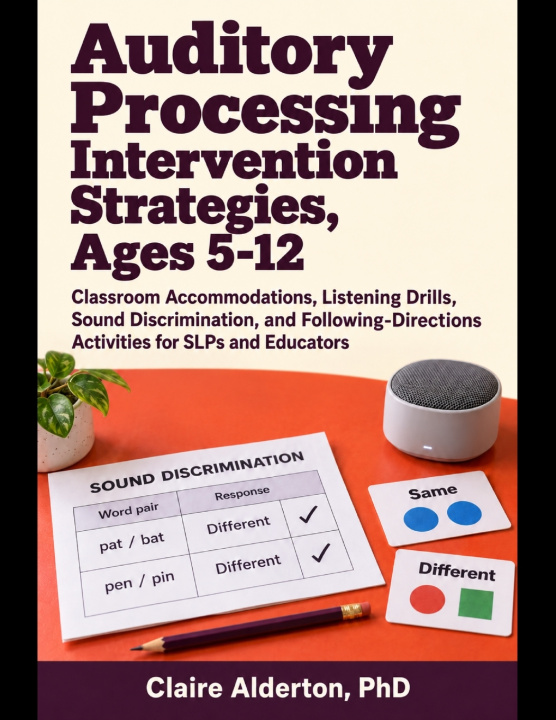
Auditory Processing Intervention Strategies, Ages 5-12
Classroom Accommodations, Listening Drills, Sound Discrimination, and Following-Directions Activities for SLPs and Educators
 Angličtina
 215 b
 Nové
Až 30 dní na vrátenie tovaru

An Auditory Processing Toolkit for Speech-Language Pathologists and Teachers
Some children ages 5 to 12 miss part of every direction you give. You can start helping them listen better this week. This book gives you room checks, drill scripts you can read aloud, and finished forms to copy.
When Every Adult Has a Different Guess
Picture a child who struggles with following directions and keeps asking you to repeat yourself. One adult suspects hearing loss, another suspects poor attention, and a third suspects weak vocabulary. Each guess may be right, and a label can take a long time to arrive. The child still has to listen on Monday morning.
Room First, Then Drills, Then Data
This book starts with what you can see, not with a label. You fix the room and the way adults talk before any drill begins. A child cannot use a skill on speech the child cannot hear clearly. Then three sets of auditory processing drills train sound discrimination, listening in noise, and following directions. Each set is a ladder of six levels with one simple rule for moving up or down. The rule gives the same answer for the same scores, so your team makes one call.
What Is Inside
Ten chapters take you from first concern to a plan your team can measure.
- Room checks: a ten-minute walk-through and five changes you can make this week.
- Accommodations: steps for directions, lessons, and tests, plus wording for IEP and Section 504 plans.
- Goals and sessions: goals with five parts and a reusable 30-minute session plan.
- Sound discrimination: six levels, from loud and soft sounds to words in noise.
- Listening in noise: a ladder from quiet to two soft voices, with safety steps first.
- Following directions: six levels, from one step to an if or unless condition.
- Carryover and data: language help, simple data tracking, team reports, and a year plan.
- Twelve completed forms: from a referral letter to data sheets and self-advocacy cards.
- Five item banks: data notation, minimal pairs, directions, noise sentences, and concept words, plus a glossary and index.
Examples and Named Sources
Five invented children carry the examples from first concern to progress report. The ideas draw on public documents named by title and publisher, so you can check the current text. These include the American Academy of Audiology guideline and the ASHA Practice Portal. They also include federal IEP and Section 504 rules and two reviews of intervention research.
If You Are Short on Time or Training
You do not need a diagnosis to begin. A diagnosis can add information, but it is not a condition for helping a child listen better today. A diagnosis belongs to the audiologist, and your job is to notice, screen, refer, and plan. The first room changes are small, and the ten-minute walk-through shows you where to start.
Plain Limits, Up Front
This book is educational, and it is not medical, audiology, or legal advice. It does not diagnose central auditory processing disorder (CAPD), and it does not replace an evaluation. Drills train a skill and accommodations give access, so the book never claims a cure. It names no tests, programs, or products, and gives no dose, so your team picks session length. Where experts disagree or the evidence is thin, the book says so.
Start With One Child This Week
Pick one child and one room that worry you most. Order the book, take the ten-minute walk-through, and write down what you hear. Then copy a completed form, read a script aloud, and score the first set of five trials. By your next team meeting, bring real numbers.


Informácie o knihe
Angličtina

Darujte túto knihu ešte dnes
Je to jednoduché
1 Pridajte knihu do košíka a vyberte možnosť doručiť ako darček 2 Obratom Vám zašleme poukaz 3 Knihu zašleme na adresu obdarovanéhoAhoj! Som Libroamiko, tvoj knižný radca.
Ako ti môžem pomôcť?