
 Kontakt
 Ako nakupovať
Doručenie
Nákupný poradca
 Angličtina
 39 b
39 b
 Nové
Nové
Až 30 dní na vrátenie tovaru

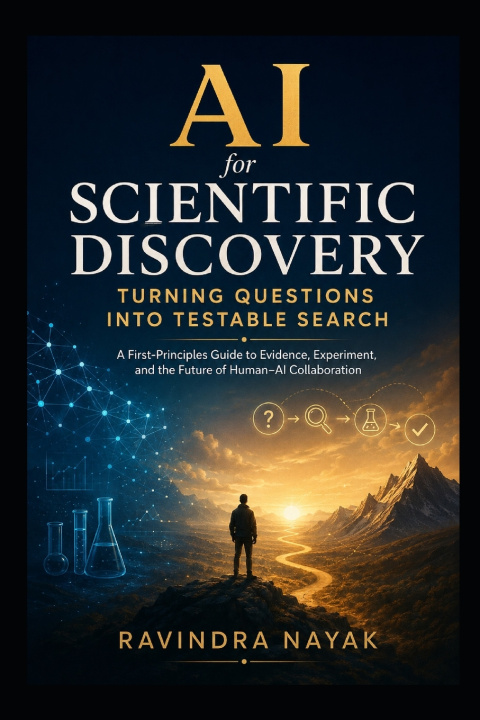
What happens when artificial intelligence can generate a hypothesis in seconds-but evidence still has to earn the right to call it discovery?
AI for Scientific Discovery: Turning Questions Into Testable Search is a first-principles guide for readers who want to understand how AI can support scientific work without confusing speed, fluency, or automation with truth. It begins with a deceptively simple skill: learning how to turn curiosity into a question that reality can actually answer.
From there, the book builds one clear layer at a time. You will learn how hypotheses become testable, how evidence gains meaning through provenance and method, how uncertainty can guide better decisions, and why a polished answer is never a substitute for an inspectable reasoning trail. The journey expands into literature search, source quality, evidence maps, scientific memory, structured data, transparent calculations, code-assisted analysis, multimodal evidence, verification loops, experiment design, simulation, experiment queues, autonomous laboratory architecture, calibration, reproducibility, robustness, benchmarks, human oversight, specialist-agent collaboration, replication, and responsible scientific orchestration.
The approach is deliberately accessible. No programming background is assumed. Advanced mathematics is not required. Small equations are used as thinking tools, with ordinary language always coming first. Dialogues between Nila and Dev turn abstract ideas into questions a curious reader might genuinely ask, while practical examples show how the same reasoning applies to workplace experiments, product claims, data dashboards, research systems, and everyday problem solving.
The final Value Edition turns the book from something you read into something you can use. Ten practical learning labs help you reconstruct ideas from memory, break complex problems into manageable chunks, trace broken evidence chains, remove fear of numbers, train hypotheses to become testable, brainstorm without drifting, debug scientific-agent workflows, and apply a product-independent Future Scientific Agent Harness to technologies that may not even exist yet.
If you want to understand AI in research without being overwhelmed by jargon-or learn how to ask better questions, evaluate evidence, design more informative tests, and know when a system should stop-this book offers a durable mental framework built around evidence, uncertainty, verification, and accountable action.
The goal is not to make every reader a specialist. It is to help every reader become harder to impress with confident answers and better equipped to ask the questions that make trustworthy discovery possible.


Informácie o knihe
Angličtina

Darujte túto knihu ešte dnes
Je to jednoduché
1 Pridajte knihu do košíka a vyberte možnosť doručiť ako darček 2 Obratom Vám zašleme poukaz 3 Knihu zašleme na adresu obdarovanéhoAhoj! Som Libroamiko, tvoj knižný radca.
Ako ti môžem pomôcť?