
 Kontakt
 Ako nakupovať
Doručenie
Nákupný poradca
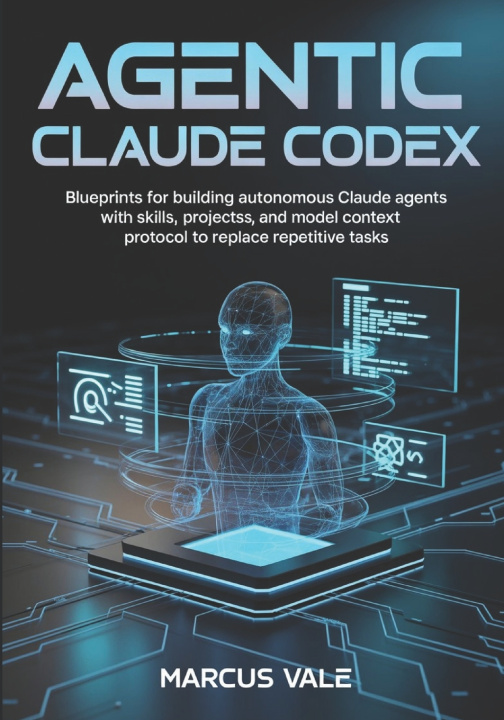
AGENTIC CLAUDE CODEX
Blueprints for Building Autonomous Claude Agents with Skills, Projects, and Model Context Protocol to Replace Repetitive Tasks
 Angličtina
 82 b
82 b
 Nové
Nové
30 dní na vrátenie tovaru

How much of your week disappears into work that nobody enjoys doing?
Think honestly. The Monday report. The inbox that grows faster than you clear it. The pre-meeting research done from scratch. The status updates, the follow-ups, the code reviews, the briefings. What would your week look like if half of that work simply happened in the background while you focused on the harder problems?
That question is no longer theoretical. can now be configured to handle this work through three building blocks: Skills, Projects, and the Model Context Protocol. The concepts themselves are not difficult. The challenge is learning how to combine them into systems that remain useful after the excitement of the first demo fades.
This book is the practical guide most teams wish they had before they started experimenting.
Marcus Vale walks through the full operational reality of building autonomous Claude agents that actually hold up in production. Not toy examples. Not vague future promises. Real workflows that working teams are already using to reduce repetitive operational work that used to consume entire days.
You will learn how to write Skills that trigger reliably and produce consistent output. How to structure Projects so agents retain useful context without drowning in irrelevant information. How the Model Context Protocol allows one agent to work across email, calendars, codebases, customer systems, and internal databases without rebuilding integrations from scratch every time. And how to design the agentic loop so the system plans, acts, observes, and adjusts within boundaries you control.
The chapters move from fundamentals to implementation to the operational reality of managing agents over time. You will see complete walkthroughs for email triage, recurring reports, research briefings, code review, and customer communication workflows. Each blueprint includes instructions, routing logic, data access patterns, and the failure modes most likely to appear in production.
The difficult questions receive equal attention. What happens when an agent gets something wrong? How do you debug a system whose reasoning is partially hidden inside a model? How do you evaluate whether a workflow is actually saving time instead of quietly creating new operational risk? When should automation stop and human judgment take over?
These are the questions that determine whether agentic systems become trusted infrastructure or abandoned experiments.
Inside, you will find:
- The four-component anatomy of an agent and how it maps to Claude's product surfaces
- How to write Skills that compose cleanly and trigger only when appropriate
- Project design patterns that scale across teams without becoming chaotic
- A walkthrough for building your first Model Context Protocol server in under fifty lines
- Authentication and permission models based on least privilege
- Six complete workflow blueprints covering common repetitive operational tasks
- A taxonomy of agent failures and recovery strategies for each category
Three appendices provide references you will continue using long after the first read. A glossary of agentic AI terminology. A production checklist for skill authoring. A starter kit for Model Context Protocol servers with a working code skeleton.
The repetitive work consuming your schedule was never the work most people were hired to do. It simply accumulated because nobody had a reliable system for handling it differently. This book explores what happens when that assumption changes..
If you want to build AI workflows that reduce repetitive work, hold up under real operational pressure, and become genuinely useful instead of quietly abandoned, this book will help you build them the right way.


Informácie o knihe
Angličtina
