
 Kontakt
 Ako nakupovať
Doručenie
Nákupný poradca
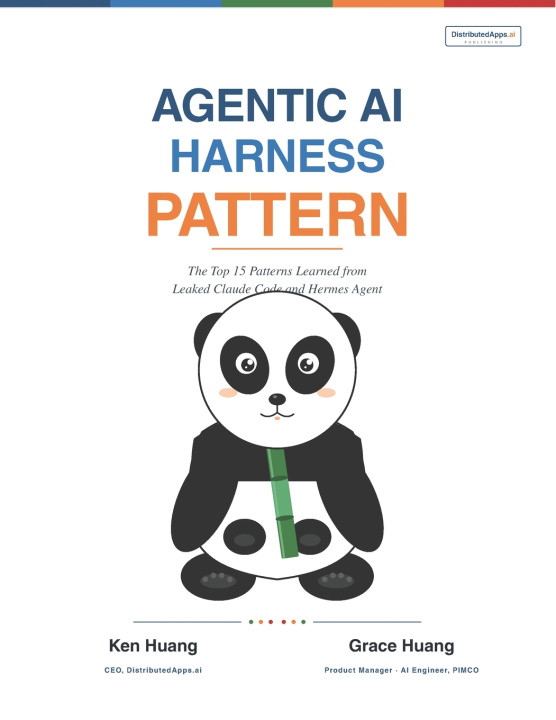
Agentic AI Harness Pattern
The Top 15 Patterns Learned from Leaked Claude Code and Hermes Agent
 Angličtina
 82 b
82 b
 Nové
Nové
30 dní na vrátenie tovaru

Most AI tutorials teach you prompts. This book teaches you patterns.
Production AI engineering - the discipline of turning a language model into something reliable, safe, auditable, and shippable - is mostly undocumented. The libraries churn every quarter. The patterns endure.
Agentic AI Harness Pattern distills 15 of those patterns by reading two mature production codebases side by side: Claude Code, Anthropic's TypeScript CLI for agentic coding, and Hermes, a Python agent built to run across messaging platforms. The two systems make different language choices, different concurrency choices, and different deployment choices - but the harness pattern they implement is the same.
Every chapter follows the same rhythm:
- Name the pattern. What problem is the harness solving?
- Show Claude Code's implementation in real TypeScript.
- Show Hermes's implementation in real Python.
- Compare them as a table. Where do they diverge, and why?
- Recommend when to use which. A decision rule, not a hot take.
- Apply the pattern to a defensive cyber-security agent. A worked example that shows the pattern under operational pressure.
Inside the 15 patterns
- The Harness Paradigm - why a model alone is not a product
- Tool Architecture and the Tool Contract - the boundary between reasoning and consequence
- The Query / Agent Loop - what happens between the model's tool call and the next turn
- Permission Systems and Safety Guardrails - gating the destructive set
- Tool Orchestration and Execution - partitioning safe vs. serial work
- Context Management at Scale - the five strategies before compaction
- Multi-Agent Coordination - when one agent isn't enough
- Memory Systems and State Persistence - three tiers, one cache
- Observability and Debugging - distributed tracing for non-deterministic systems
- Production Deployment Patterns - SDK-first vs. gateway-first
- Hook / Event-Driven Automation - the layer above the loop
- The Skill System Pattern - capabilities as content, not code
- MCP Integration - connecting agents to the world
- Model Routing and Provider Abstraction - falling back without falling over
- Structured Output and Schema-Constrained Generation - when free text isn't enough
Who this book is for
- Engineers building AI products who keep hitting the same architectural questions and want vetted answers.
- Architects and tech leads making the build-vs-buy-vs-wrap decision for an agent platform.
- Security and compliance reviewers who need to understand how a production agent enforces a destructive-action gate, an audit trail, and an iteration budget.
Each chapter stands alone. Read what you need; read end-to-end and the patterns compound. Either way, you'll close the book with a working mental model of how to design an AI agent that survives contact with production.
About the authors
Ken Huang is CEO of DistributedApps.ai, advising organizations on production-grade agent deployment at the intersection of AI, distributed systems, and security.
Grace Huang is a Product Manager and AI Engineer at PIMCO, where she ships AI features for the world's largest fixed-income asset manager. Her focus is the engineering rigor that makes AI products trustworthy in regulated environments.
The model is intelligence. The harness is the system.
Start here.


Informácie o knihe
Angličtina
