
 Kontakt
 Ako nakupovať
Doručenie
Nákupný poradca
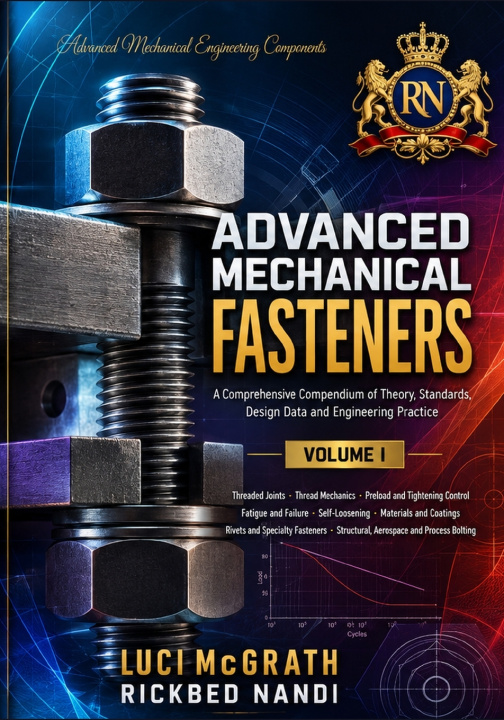
ADVANCED MECHANICAL FASTENERS (Volume 1)
A Comprehensive Compendium of Theory, Standards, Design Data and Engineering Practice
 Angličtina
 45 b
45 b
 Nové
Nové
Až 30 dní na vrátenie tovaru

PREFACE
A modern airliner contains on the order of three million fasteners. A mid-size passenger car contains between two and four thousand. A utility-scale wind turbine tower is held together by several thousand high-strength bolts, each of which must retain its clamp force through twenty years of reversing load in a corrosive atmosphere with essentially no maintenance. In every one of these products the fastener is the cheapest component per unit and, statistically, one of the most likely to be implicated when something comes apart.
That paradox is the reason this book exists. Fasteners are treated as commodity hardware - ordered by the box, specified by a line in a bill of materials, and torqued to whatever number a chart happened to give. Yet the bolted joint is one of the few machine elements whose performance is created at assembly rather than at manufacture. A perfect bolt, correctly specified and made to the tightest class, will fail in fatigue in a fortnight if it is installed at a quarter of the clamp force the designer assumed. No amount of material quality compensates for a joint that was never properly tightened.
The central argument of this compendium is therefore simple: a bolted joint is a preload machine. Its purpose is not to "hold parts together" in some vague sense, but to establish and maintain a specific compressive force between clamped members. Almost everything that follows - thread geometry, friction, the torque coefficient, joint stiffness, embedment, fatigue behaviour, self-loosening, locking devices, tightening control, ultrasonic measurement - is in service of one question: how much clamp force is actually in that joint, and will it still be there tomorrow?
This is a compendium rather than a textbook or a handbook, and the distinction matters. A textbook develops a subject linearly for a student. A handbook tabulates data for a practitioner. This book attempts both, in the belief that the numbers are only usable when the reader knows where they came from and what assumptions they carry.
Accordingly, every significant relationship is developed from first principles and then reduced to the working form actually used in practice. Every table carries the standard or source that governs it. Where sources disagree - and on several important quantities they do - the disagreement is stated openly rather than averaged away. Two examples that recur in the text: the shear allowable for the 2117 aluminium rivet is 26 ksi as a raw material specification but 30 ksi as an MMPDS driven-condition design allowable; and the Wileman member-stiffness constants exist in both a material-specific and an averaged form, which give materially different answers for aluminium joints. Knowing which figure applies is more valuable than having a single confident number.
A first course in mechanics of materials - stress, strain, Mohr's circle, the concept of a factor of safety - is assumed. Beyond that, the book is self-contained. Readers approaching from manufacturing, quality, maintenance or failure analysis rather than design should find the derivations skippable without losing the practical content; the working equations are boxed or numbered and the tables stand alone.
Standards are cited as authorities, not reproduced as content: this book will tell you that ISO 898-1 defines property class 10.9 as a nominal 1040 MPa tensile strength with a 0.2 % proof stress of 940 MPa, and it will explain the logic of the class designation system, but it is not a substitute for the standard itself. Standards are revised. The 2020 revision of ISO 3506 alone added duplex grades and a property class 100 that did not exist in earlier editions. Verify before you specify.
L. McG.


Informácie o knihe
Angličtina

Darujte túto knihu ešte dnes
Je to jednoduché
1 Pridajte knihu do košíka a vyberte možnosť doručiť ako darček 2 Obratom Vám zašleme poukaz 3 Knihu zašleme na adresu obdarovanéhoAhoj! Som Libroamiko, tvoj knižný radca.
Ako ti môžem pomôcť?